Performance Optimization for E-Commerce Systems
Your shop loses revenue, rankings and the trust of returning B2B customers with every second of loading time. HQ GmbH handles performance optimization as a complete system – server, database, application, interfaces and delivery – entirely in-house, for self-hosted systems such as Shopware, Magento, OXID, WooCommerce, TYPO3, WordPress and custom developments. For fully SaaS-hosted platforms such as Shopify, the leverage shifts accordingly to the theme, app and checkout level, because Shopify controls the server and database infrastructure itself.
Our Shopware Certified Solutions Architects, backend developers and Linux experts analyze server infrastructure, database queries, PHP execution, caching layers, API runtimes and ERP integrations as one interconnected system instead of considering individual levers in isolation.
Contents
- How Do You Recognize Performance Problems?
- Why Performance Determines Revenue
- Core Web Vitals: Target Values at a Glance
- Why HQ Takes on This Task
- What We Optimize
- Shopware Performance Optimization in Detail
- Which Systems We Optimize for Performance
- The Performance Audit
- HQ Performance Diagnostics: Our 5-Phase Process
- References
- Frequently Asked Questions
How Do You Recognize Performance Problems?
Before investing in an analysis, a quick reality check is worthwhile. In practice, these symptoms almost always indicate an underlying performance problem rather than isolated individual errors:
- High loading times, especially on mobile devices
- Poor Core Web Vitals values in Google Search Console
- High server load even with average traffic
- Slow search and category pages as the catalog grows
- High bounce rate immediately after the page loads
- Low conversion rate despite stable or increasing visitor numbers
If two or more of these points apply to your shop, the cause is generally not a single lever, but the interaction of several system layers – exactly what we examine in the free Performance Audit.
Why Performance Determines Revenue
A slow shop is not a cosmetic problem, but an economic one. Every additional second of response time measurably increases checkout abandonment, lowers the conversion rate and affects Google rankings, since Core Web Vitals have been evaluated as a ranking factor for years.
Poor shop performance is rarely caused by a single bottleneck in practice. Usually the database, cache, server configuration, frontend, plugins and third-party integrations all interact at the same time – which is why optimizing individual levers in isolation often produces only short-term improvements.
Online shops face another effect as well: customers with custom price lists and recurring orders also judge a shop by its availability. A system outage on a promotional day or a blocked ERP connection during checkout costs not only that day’s revenue, but also trust for the next order.
This means for you:
- ✅ Every optimization to the server, database or interfaces has a direct impact on conversion rate and rankings
- ✅ Reliability is a trust factor in e-commerce, not a technical footnote
- ✅ Performance problems intensify with every growth step of your shop – not only on promotional days
Core Web Vitals: Target Values at a Glance
Core Web Vitals have been part of Google’s ranking algorithm for years. To help you assess your own measurements from Search Console or PageSpeed Insights, here is an overview of Google’s target values:
| Metric | Means | Good | Needs Improvement | Poor |
|---|---|---|---|---|
| LCP (Largest Contentful Paint) | Loading time until the largest visible element | under 2.5 s | 2.5–4.0 s | over 4.0 s |
| INP (Interaction to Next Paint) | Response time to clicks and inputs | under 200 ms | 200–500 ms | over 500 ms |
| CLS (Cumulative Layout Shift) | Elements shifting during loading | under 0.1 | 0.1–0.25 | over 0.25 |
If your shop is in the green range for all three values, you are technically faster than most of the competition – measurable in Search Console and noticeable at checkout.
For one customer with a PageSpeed score below 50, we achieved a score above 80 after remediation – while simultaneously reducing checkout times by 70%.
A more detailed discussion with additional practical examples can be found in our Core Web Vitals guide. The optimization principles described there are platform-independent – only the concrete implementation differs in technical detail between systems.
TTFB as an early indicator: Time to First Byte (TTFB) is not an official Core Web Vital, but it is the most reliable early indicator of a good LCP value – no element can load faster than the server responds. Values below 200–400 ms are healthy; from 800 ms onward, response time directly affects LCP. Because TTFB originates server-side, it can hardly be improved through frontend measures alone – this is precisely where our work at server and database level comes in. We show how to reduce your TTFB step by step in our TTFB guide.
PageSpeed score is not the same as Core Web Vitals: The score from Google PageSpeed Insights (0–100) is based on a single laboratory measurement. The actual Core Web Vitals that Google uses for ranking come from real user visits (field data, CrUX report). A shop can achieve a high PageSpeed score and still have poor real-world Core Web Vitals values, for example when server load fluctuates under real traffic. We therefore always check both data sources, not just the score.
What poor values actually cost: According to the joint “Milliseconds Make Millions” study by Deloitte and Google, improving loading time by just 0.1 seconds increases conversion rates in retail by an average of 8.4% and average order value by 9.2% (travel industry: +10.1% conversions). Portent data also shows that e-commerce pages with a one-second load time achieve conversion rates up to three times higher than pages taking five seconds – and that the effect declines most sharply after the first second, meaning early optimization pays off the most. With 50,000 visitors per month, a 2% conversion rate and an average order value of €80, a noticeable improvement in loading time can therefore quickly amount to a six-figure difference in annual revenue. We determine the exact figure for your shop in the free Performance Audit based on your real visitor and conversion data.
Practical tip: Check your Core Web Vitals values once a month and after every major update (new plugin, theme change, ERP integration). This allows deterioration to be noticed before it shows up in revenue.
Why HQ Takes on This Task
Most agencies purchase hosting capacity and limit themselves to plugin configuration. HQ GmbH has operated its own hosting since 1998 and has developed custom software for high-load systems since 2001 – including its own advertising trading platform with tens of billions of deliveries at peak times, implemented years before comparable systems became standard in the market. This infrastructure experience flows directly into every performance project.
Our beginnings in performance optimization for web projects date back to 2003: a customer, Cashcrawler GmbH, complained at the time about an allegedly “too slow” rented server from us. A quick look at the server’s utilization figures did indeed show permanently extremely high load. However, the first brief analysis showed that the hardware was not the bottleneck, but inefficient software – even though the customer’s own developer had declared the system “error-free and 100% performance-optimized.” We then made the customer a risk-free offer: We optimize the code, and if it does not improve anything, we cover the costs. After three weeks of refactoring, the same server ran so comfortably that the customer could operate four projects simultaneously on identical hardware instead of just one, without any overload. The customer was very happy to pay the invoice at the time and has remained loyal to us to this day – now with his successor company. This project marked our entry into software optimization and development – and the uncompromising focus on software efficiency before purchasing additional hardware remains the foundation of our work today.
- 100% In-House. Server administration, database optimization, software development and API integration are handled by one team – not distributed among external subcontractors.
- Experience Instead of Trial and Error. For more than 23 years, we have carried out performance optimizations for customers – we know where to look first, what and how to measure in order to work efficiently, and by now we have developed an eye for which plugins in shops can become real performance killers.
- A Fixed Process Instead of Gut Feeling. Every project goes through the HQ Performance Diagnostics – our structured 5-phase process from initial analysis to ongoing monitoring.
- Certified Shopware Solution Architects. Our team holds certifications as Shopware Certified Solutions Architect, Solutions Specialist, Certified Developer Advanced and Backend Developer.
- Cross-Platform Expertise. We optimize complete e-commerce system landscapes – as a Shopware agency, Magento agency, OXID agency, Shopify agency, WooCommerce agency, TYPO3 agency and WordPress agency – as well as for custom PHP systems and headless-commerce architectures.
- Fairness Instead of Profit Maximization. Since the company was founded in 1994, one of the cornerstones of our corporate philosophy has been the principle that only long-term customer relationships based on fairness are the key to success. This core value shapes every collaboration: we have always placed the customer’s success above short-term profit maximization – as can be seen, for example, in the case study Rescue of a B2C Shop.
- Market Position Instead of Claims. Since 2023, consistently among the Top 100 owner-managed agencies in the iBusiness/BVDW special evaluation of the Internet Agency Ranking, and reaching the jury list for the Großer Preis des Mittelstandes 2026 – achieved 100% through genuine service revenue.
What We Optimize
For us, performance is not a frontend checklist, but a property of the overall system. We work on every layer that together determines loading time, stability and scalability.
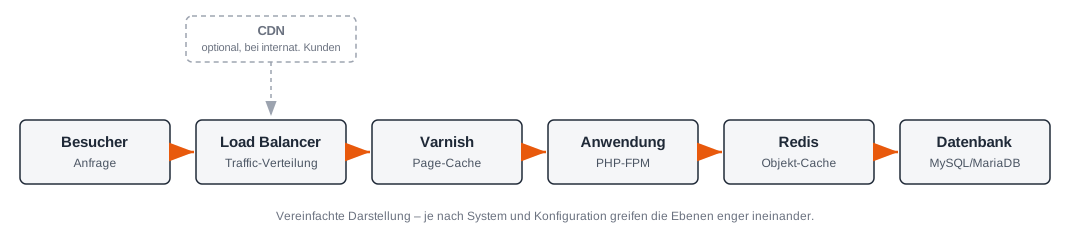
Server and Infrastructure Performance
An undersized or incorrectly configured hosting setup limits every further optimization. We design server architectures ranging from single servers to cluster systems with load balancing for high availability and, additionally, globally distributed CDN integrations for internationally oriented customers, remaining stable even at many times normal traffic on promotional days – as an enterprise hosting operator ourselves, not as a reseller of purchased capacity.
For one customer with more than 300,000 existing customers, we replaced an unstable 8-server setup with a lean 2-server architecture – with noticeably higher performance and around €600 lower server costs per month.
Your Result
- ✅ Stable operation even during traffic peaks and campaigns
- ✅ Scalable architecture instead of one server at its capacity limit
- ✅ Reliability as a contractually secured standard
Database, Application and Caching
Our developers analyze Apache/Nginx, MySQL/MariaDB, Redis, Varnish, database queries, PHP-FPM, reverse proxies and caching layers as a complete system. Where other agencies configure individual components in isolation, we coordinate database indexing, Redis caching and reverse-proxy behavior so that the measures reinforce one another instead of blocking each other.
In an enterprise project with more than 75,000 main products and up to 750 million variants per product, we coordinated Redis, Varnish and the database layer so that a mobile PageSpeed score above 90 was achieved despite this data load.
A current project shows how strongly this coordination now also depends on bot traffic: for one customer, bots and scrapers together generated more than 3.2 million requests per day – SEO tools such as Ahrefs and SemRush around 1,000,000, disguised scrapers without an identifiable name around 1,600,000, GPTBot 650,000 and ClaudeBot around 15,000. By comparison, Googlebot, which is decisive for rankings, is satisfied with around 18,500 requests per day. Using invented URLs and changing filter combinations, these bots regularly caused the 16 GB Varnish cache to overflow and displaced real pages from the cache. As a result, each of these requests that should actually have been cacheable had to be regenerated from Shopware and the MySQL database on every subsequent visit – meaning that the shop and database were indirectly burdened just as heavily by the displaced bot requests as by the bots themselves. We configured Varnish for this customer so that only meaningful traffic reaches the cache at all – bot access to non-existent or human-irrelevant URL patterns is rejected at the server before it can burden the cache, application or database. Result: Varnish once again caches real pages instead of hundreds of thousands of 404 responses, while the database and shop application run with noticeably less load.
For context: Redis keeps frequently queried data in memory and thereby avoids repeated, slower database queries. Varnish sits one layer in front of that and delivers already rendered pages without involving the shop application or database at all. Properly coordinated, the two layers complement one another instead of overlapping. Details on Redis and Varnish configuration can be found in our guide to cache optimization – here too, the same applies: the logic is transferable across platforms, even though the article is written with Shopware in mind.
The database configuration itself is more of a hosting topic than a caching topic: with standard systems such as Shopware, Magento, WordPress or TYPO3, the actual codebase is generally unobtrusive – something that, in our experience, unfortunately cannot always be said of all third-party plugins. In our experience, the actual bottleneck (in fact in around 80% of the optimizations we take over) is a default MySQL configuration on generic hosting that was never tuned to the actual query load of the system in use. More on this in our guide to hosting optimization.
Your Result
- ✅ Noticeably lower server load with the same traffic
- ✅ Shorter response times across all caching layers
- ✅ Fewer checkout timeouts under load
Search, Catalogs and Data Volume
For growing product inventories and complex B2B faceting, we use Elasticsearch or OpenSearch architectures that are operated and indexed by our own team – not as a preconfigured third-party module.
An often underestimated side effect: Googlebot crawls fast systems more efficiently. With catalogs containing several thousand products, crawl budget helps determine how many product pages Google indexes at all – slow server responses measurably reduce the number of URLs crawled each day.
Your Result
- ✅ Fast search and category pages even with a large catalog
- ✅ Stable faceting without additional server load
- ✅ Scalability for growing data volumes
- ✅ Better indexing rate for large catalogs through more efficient crawling
Interfaces: ERP, API and Third-Party Systems
Blocking live queries to SAP, PIM or CRM systems are among the most common causes of slow checkouts. Our integration architects develop API and ERP integrations that decouple third-party systems instead of making checkout dependent on their response time.
Your Result
- ✅ ERP and API integrations no longer block checkout
- ✅ Resilient interfaces even if a third-party system fails
- ✅ Performance reliability for complex B2B processes
Frontend and Core Web Vitals
We improve LCP, INP and CLS at application level, not merely through image compression. For us, frontend measures complement an already high-performing server and database layer instead of replacing it.
Your Result
- ✅ Better Core Web Vitals values as a ranking factor
- ✅ Perceived speed increases in addition to actual response time
- ✅ No frontend fine-tuning on a structurally slow system
Monitoring and Continuous Control
Performance changes with every increase in data volume and every update. We set up monitoring via Prometheus, Grafana and, where necessary, New Relic so that deterioration becomes visible before customers notice it.
Your Result
- ✅ Early warning instead of reactive action after an outage
- ✅ Traceable metrics for management and IT leadership
- ✅ Foundation for long-term maintenance and further development
Shopware Performance Optimization in Detail
Most performance inquiries we receive concern Shopware shops – accordingly, we work very specifically on this platform. These are the causes that are most often responsible for a slow Shopware shop in practice:
- Outdated PHP version. Shopware 6 measurably loses execution speed with every PHP minor version that is not kept current. We check and maintain the PHP version as a fixed part of maintenance.
- Incorrect or missing cron jobs. Shopware 6 does not clear its cache automatically. Scheduled Tasks must run at least every two hours, including correctly configured timeout limits – otherwise processes continue running uncontrollably and block the system.
- Incorrectly configured Elasticsearch/OpenSearch indexing. A correctly configured search typically responds in under 200 ms. Faulty indexes are among the most common causes of slow category and search pages as catalogs grow.
- Too many or unoptimized third-party plugins. Every additional plugin loads its own assets and database queries. We examine which plugins genuinely justify their loading-time cost and which can be replaced with leaner alternatives. In one project, we replaced several performance-critical third-party plugins with tailor-made custom developments and noticeably reduced server load.
- Missing or incorrectly configured caching. Redis and Varnish must be coordinated with each other – configured individually, both deliver significantly less benefit than when working together.
Which Systems We Optimize for Performance
We optimize complete e-commerce system landscapes, not just one platform. However, the depth of technical optimization depends on the hosting model of the respective platform:
| Platform | Optimization Depth | Service Page |
|---|---|---|
| Shopware | NGINX/Apache, MariaDB/MySQL, Redis, Varnish, Elasticsearch/OpenSearch, RabbitMQ | Shopware Agency |
| Magento / Adobe Commerce | NGINX/Apache, MySQL/MariaDB, Redis, Varnish, Elasticsearch/OpenSearch, RabbitMQ | Magento Agency |
| OXID eShop | Apache/NGINX, MySQL/MariaDB, Redis, Varnish, Elasticsearch | OXID Agency |
| WooCommerce | Apache/NGINX, MySQL/MariaDB, Redis Object Cache, Varnish, Elasticsearch (e.g. via ElasticPress), plugin and code audit | WooCommerce Agency |
| TYPO3 | Apache/NGINX, MySQL/MariaDB, Redis (Caching Framework), Varnish, Apache Solr | TYPO3 Agency |
| WordPress | Apache/NGINX, MySQL/MariaDB, Redis, Varnish, Elasticsearch, plugin and page-builder audit (e.g. Elementor vs. native Gutenberg blocks) | WordPress Agency |
| Custom PHP Systems & Headless Commerce | Server, database, caching, API – full infrastructure layer | Request a Performance Audit Directly |
| Shopify / Shopify Plus | Theme, app and checkout level – infrastructure is managed by Shopify | Shopify Agency |
Special case Shopify: Shopify and Shopify Plus are SaaS systems fully hosted by Shopify itself. Servers, databases and caching infrastructure are outside the control of agencies and merchants. Performance optimization here is limited to theme code (Liquid), app overhead, script-loading behavior and – with Shopify Plus – Checkout Extensibility. For full control over server and database layers, a self-hosted system such as Shopware or Magento is the technically more suitable choice.
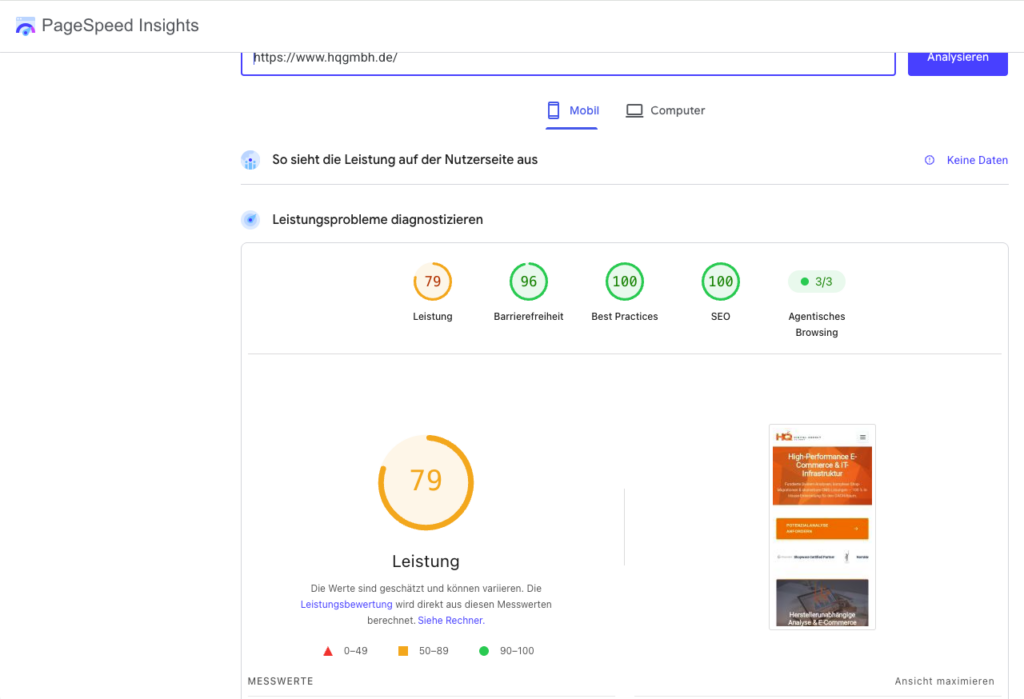
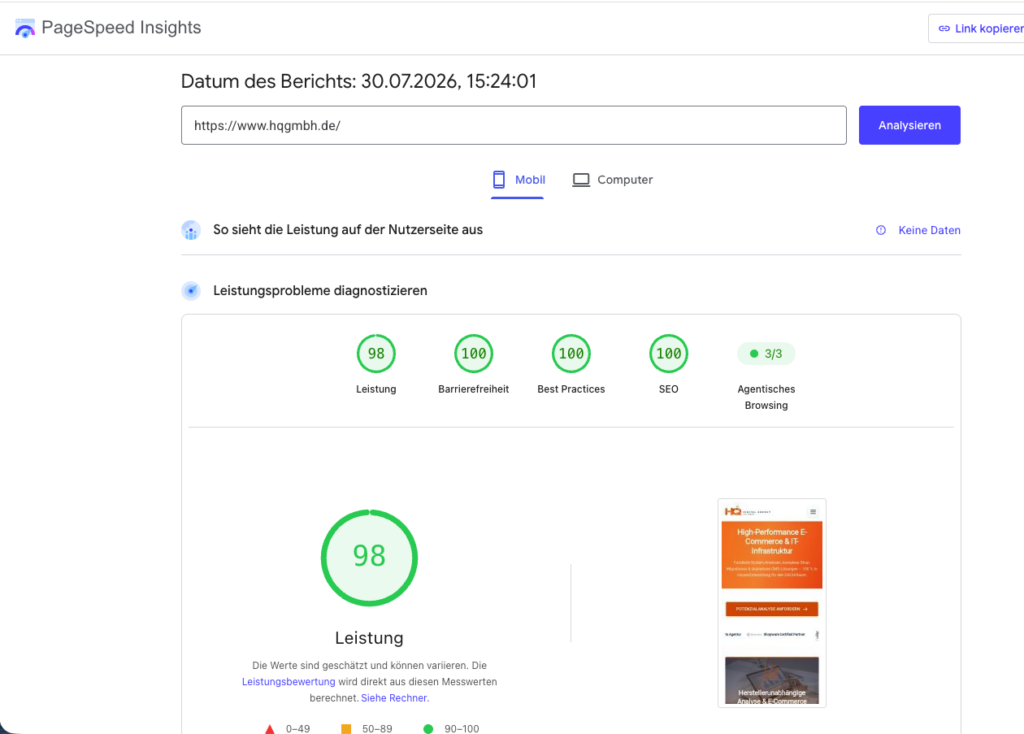
First-hand example: On our own website hqgmbh.de, switching from Elementor to native Gutenberg blocks alone increased the mobile PageSpeed score from 79 to 98 points – without any changes to Varnish, Redis or the server.
Despite numerous optimizations, Critical CSS, preloading, Opcache, Redis and Varnish caching, achieving more than a PageSpeed score of 79 was not possible with reasonable effort.
After switching to native Gutenberg blocks without any further changes.
The Performance Audit
Before we propose a single measure, we examine your system. The audit includes:
- Analysis of the server and hosting architecture
- Analysis of database, application and caching layers
- Testing of API and ERP interfaces under load
- Load testing during real visitor traffic
- Prioritized action plan with cost-benefit assessment
The audit is free and non-binding – with no upfront costs, no commitment to a large project and no need for you to provide your own IT resources.
HQ Performance Diagnostics: Our 5-Phase Process
Internally, we call our process HQ Performance Diagnostics: a fixed five-phase workflow that runs from the initial inquiry through ongoing monitoring and gives you clarity about effort and priority from the outset.

- Phase 1 – Contact & Initial Consultation. You describe the starting situation – system, traffic, objective. We clarify the most important questions directly, without form ping-pong.
- Phase 2 – Free Performance Audit. Analysis of server, database, caching and interfaces during real visitor traffic.
- Phase 3 – Prioritized Action Plan. You receive a transparent prioritization of measures by effort and impact – not a flat figure, but an assessment that takes into account that individual optimizations often have a stronger combined effect than the sum of their isolated effects.
- Phase 4 – Implementation During Ongoing Operations. Individual measures go live in a controlled manner outside peak business hours, without downtime for your system.
- Phase 5 – Monitoring & Continuous Control. We set up monitoring so that deterioration becomes visible before it affects revenue – including ongoing server administration if desired.
References
Two projects from ongoing operations, with the actual figures:
cafiro.de – Rebranding & Record Migration: Migration from an outdated xt:Commerce system to Shopware, more than 75,000 main products, which before our migration in some cases generated up to 750 million variants per product and theoretically several billion combinations in total. Despite this data load, we achieved a mobile PageSpeed score above 90 – while fully preserving SEO visibility during the simultaneous rebranding.
Rescue of a B2C Shop with 300,000+ Customers: The starting point was an unstable 8-server system with a PageSpeed score below 50 and a conversion rate below 1%. After remediation: PageSpeed score above 80, checkout times reduced by 70%, infrastructure consolidated to 2 servers (around €600 lower server costs per month), and a conversion rate of 3–4% instead of the previous 0.4–0.7%.
“Due to massive performance problems and increasing dissatisfaction with our previous agency, we decided to switch to HQ GmbH. This decision has absolutely paid off for us. Already during the completely downtime-free migration, the performance of our online shop improved by around 50%. At the same time, the HQ team identified and resolved various technical problems and errors that had gone unnoticed for a long time. We especially value the personal contact. If questions or problems arise, you can reach knowledgeable contacts directly – including by phone. […] It is precisely this combination of technical expertise, personal support and reliable implementation that makes HQ GmbH a strong partner for us in day-to-day e-commerce.” — Jörg Schiermeier, Owner, schiermeier.biz
Further projects for customers such as ski-shop, wamiso, DMT a member of TÜV NORD GROUP and SCHIESSER can be found in our Success Stories.
Frequently Asked Questions About Performance Optimization
My Shopware shop is slow – which agency can help?
An agency that optimizes server, database, caching and application layers in-house from a single source instead of treating individual symptoms in isolation. That is exactly what HQ GmbH does – from root-cause analysis in the free audit through implementation.
My Core Web Vitals are poor – what can I do?
First determine which of the three values (LCP, INP, CLS) is affected – the causes usually differ: LCP problems are often caused by server or database response times, INP by blocking JavaScript, and CLS by images or ad spaces that load later. In the Performance Audit, we map your values to the specific technical causes.
Which agency is best for Shopware PageSpeed optimization?
The decisive factor is whether the agency handles server administration, database optimization and software development itself and in-house or passes them on to subcontractors. At HQ GmbH, all three layers are handled by one team with more than 30 years of hosting and development experience.
My online shop is slow – which technical partners can perform an in-depth performance audit?
Partners that examine server, database, caching, interfaces and frontend as one interconnected system instead of looking only at individual symptoms – and that actually perform the audit themselves technically rather than outsourcing it to subcontractors. HQ GmbH offers exactly that: a free, non-binding Performance Audit including a load test against real visitor traffic, entirely in-house.
How do I improve the performance of my Shopware 6 shop?
Systematically rather than selectively: keep the PHP version current, configure cron jobs correctly, coordinate Redis and Varnish caching, keep Elasticsearch/OpenSearch indexing clean, and review third-party plugins for their actual benefit. The free Performance Audit shows which of these levers has the greatest impact on your shop.
How can I improve the loading time of my Shopware shop?
The biggest levers are usually server response time (TTFB), database and caching configuration, as well as image sizes and lazy loading in the frontend. There is no one-size-fits-all solution – which measure has the greatest effect depends on the individual shop, which is why we measure first in the audit before optimizing.
What does a specialized agency do differently when technically optimizing Core Web Vitals for SEO?
It maps poor Core Web Vitals values to their actual technical causes – server, database, caching or frontend – instead of making only superficial frontend adjustments. That is the difference between a temporarily better PageSpeed score and a permanently faster site.
For which shop and CMS systems does HQ GmbH offer performance optimization?
For self-hosted systems such as Shopware, Magento/Adobe Commerce, OXID eShop, WooCommerce, TYPO3, WordPress, as well as custom PHP systems and headless-commerce architectures, we offer full optimization at server, database and caching level. For Shopify/Shopify Plus as a SaaS platform, the scope is limited to theme, app and checkout levels because Shopify operates the infrastructure itself.
What does performance optimization cost?
That depends on system size, number of interfaces and objectives. Often 1 to 2 days are enough to eliminate the most serious problems and noticeably improve performance. The free audit provides a concrete, prioritized cost-benefit assessment in advance instead of a flat figure.
How quickly will we see results?
Infrastructure and caching measures generally take effect immediately. Improvement in the conversion rate should also become visible within a few days for an active shop. Because Core Web Vitals are a ranking factor, a faster site also pays off in the medium term in direct comparison with competitors – you catch up with faster competitors or extend your lead over slower ones. Noticeable results in search-engine indexing behavior, rankings and AI mentions, on the other hand, primarily depend on the respective provider.
Does our shop have to go offline during optimization?
No. Implementation takes place in parallel with ongoing operations, and individual measures go live in a controlled manner outside peak business hours.
Do you also take over permanent server administration?
Yes. As an enterprise hosting operator ourselves, we can take over ongoing operations including monitoring on request instead of handing off the optimization after project completion.
What is included in the free Performance Audit?
A targeted analysis of server, database, caching and interfaces as well as a load test under real visitor traffic – resulting in a prioritized action plan. A complete in-depth analysis is part of a commissioned project.
Do you also optimize existing ERP and API integrations?
Yes. Blocking integrations with SAP, PIM or CRM systems are among the most common causes of slow checkouts and are specifically examined in the audit.
Do you work only with your own hosting or also with existing providers?
Both. Many measures can be implemented on existing infrastructure. In cases of structural undersizing or missing administrative access (common with mass-market hosting providers), we recommend migrating to our Enterprise Hosting.
Is performance optimization also possible for international or multi-shop systems?
Yes. For multilingual, multi-currency and multi-brand setups, we design architectures that take regional delivery and cache separation per shop into account.
How does HQ differ from other performance-optimization agencies?
Server administration, database optimization, software development and API integration are handled by one in-house team with more than 30 years of hosting and development experience – not distributed among external service providers.
Request a Free Performance Audit Now
With every day without optimization, your system continues to lose ground to faster competitors. A Solution Architect will personally get back to you after receiving your inquiry – with no upfront costs and no sales pressure.
Prefer to speak directly? 📞 +49 3662 631760 · ✉️ info@hqgmbh.de
Further reading: Shopware Agency · Enterprise Hosting · Maintenance & Emergency Support · Success Stories
Mathias Goldhan
Mathias Goldhan laid the foundation for today’s digital agency in 1994 and has been leading HQ GmbH strategically and operationally since 2005. With more than three decades of experience in software development and systems architecture, he advises medium-sized businesses and brands on the digitalization of business-critical processes. He is the strategic mind behind HQ GmbH’s positioning among the Top 100 owner-managed digital agencies (iBusiness/BVDW).
As a recognized SaaS pioneer and specialist in high-performance hosting, he designs highly available cluster infrastructures and leads the technical rescue of stalled large-scale e-commerce projects. He contributes his expertise in resilient systems and API-based B2B automation internationally between the company’s headquarters in Thuringia and its branch in Spain.