OXID to Shopware Migration: Enterprise Replatforming Without Data Loss or SEO Risk
Companies that want to replace an existing e-commerce service provider or modernize their shop system often face the same challenges as with a traditional Shopware agency change. While our central overview covers the organizational and technical aspects of a Shopware agency change this guide focuses on the secure migration from OXID eShop to Shopware 6. For many established online shops, migrating to Shopware 6 is not merely an IT project, but a strategic necessity in order to remain capable of acting in enterprise e-commerce. This article examines the critical aspects of such a system replacement and shows how a transition can be ensured without SEO losses while fully exploiting the performance advantages of a modern platform architecture.
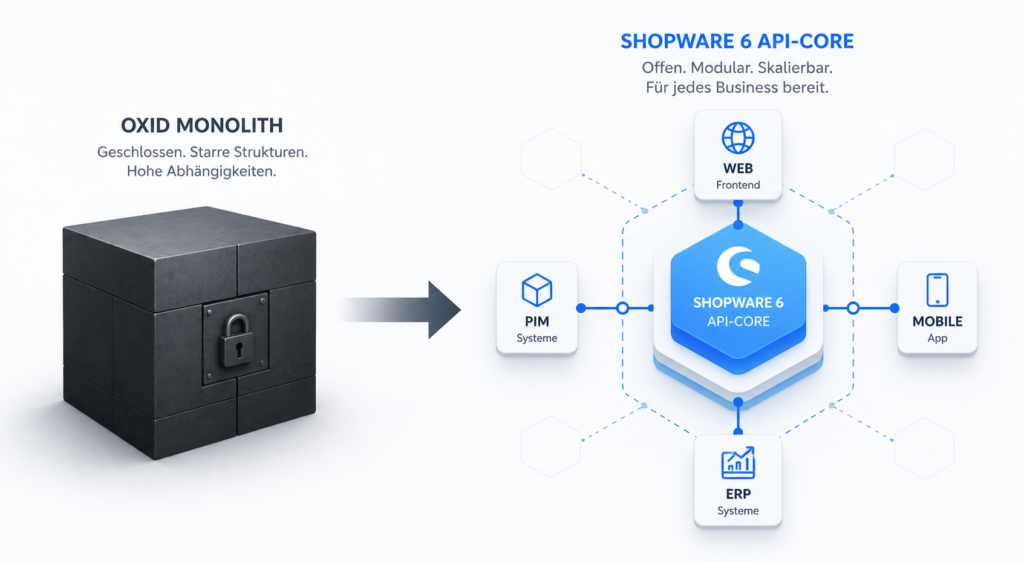
Why Switching from OXID eShop to Shopware 6 Is Unavoidable
Many companies have operated their OXID eShop installation successfully for years and invested considerable resources in custom modules, ERP integrations and business-specific processes. However, as requirements for internationalization, API integrations, B2B functionality and long-term updatability increase, many historically grown OXID systems reach technical and economic limits. The following comparison shows the most important differences between OXID eShop and Shopware 6 from the perspective of growing e-commerce companies.
OXID eShop vs. Shopware 6 in a Direct System Comparison
| Comparison Criterion | OXID eShop | Shopware 6 |
|---|---|---|
| API Architecture | Partially extended individually | API-first architecture |
| Extensibility | Often highly customized | Standardized plugin architecture |
| B2B Functions | Custom development often required | Native B2B Suite available from Evolve |
| Rule Builder | Not available | Included as standard |
| Sales Channels | Limited | Natively integrated |
| Headless Commerce | Only through custom development | Natively supported |
| ERP Integrations | Project-dependent | Extensive API ecosystem |
| Developer Availability | Comparatively smaller market | Large developer community |
| Updatability | Often restricted by legacy modules | Updatable over the long term |
| Future Viability | Often legacy structures | Modern platform architecture |
Typical Technical Legacy Issues in Established OXID Systems
Before a migration, we first analyze the technical starting point of the existing OXID system. In practice, we repeatedly encounter similar legacy issues that restrict updatability, performance and long-term maintainability.
| Technical Legacy Issue | Typical Effects |
|---|---|
| Historical Custom Modules | Lack of updatability and high maintenance costs |
| Direct Core Modifications | Conflicts during updates and difficult troubleshooting |
| Proprietary ERP Interfaces | Dependence on individual developers or service providers |
| Outdated Template Structures | High effort for design adjustments |
| Missing Technical Documentation | Increased project risk when changing agencies |
| Unsupported PHP Versions | Security and performance problems |
| Custom Database Extensions | More difficult data migration to Shopware 6 |
Outdated Legacy Systems as a Brake on Your E-Commerce Growth
Established online shops that are still based on older OXID eShop versions increasingly face challenges that can significantly slow their growth. These legacy systems were often developed at a time when requirements for scalability, flexibility and integration were different. The monolithic architecture of many older OXID installations not only makes it more difficult to implement new features and adapt to current market requirements, but also leads to higher operating costs and security risks. Maintaining and further developing such systems also ties up valuable resources and prevents rapid responses to changing customer needs and technological innovations in e-commerce. Switching away from OXID eShop is therefore often the only way out of this technological dead end.
The Advantages of a Modern API-First & Headless Architecture
Switching to a modern shop system such as Shopware 6, which is based on an API-first and headless architecture, opens up a wide range of strategic advantages. This architecture decouples the frontend from the backend, enabling unprecedented flexibility in designing the shopping experience. Developers can create tailor-made frontends for different channels (web, mobile, IoT) without having to adapt the backend. The API-first philosophy ensures integration with systems such as ERP, PIM and CRM. At the same time, it guarantees data integrity across all business processes. This leads to a significant acceleration of time-to-market for new features and a substantial reduction in complexity when scaling the online shop. Migrating from OXID to Shopware 6 is therefore a fundamental step toward future viability and a technology change that strengthens the company’s capacity for innovation.
Our Roadmap for Secure Data Migration & System Replacement

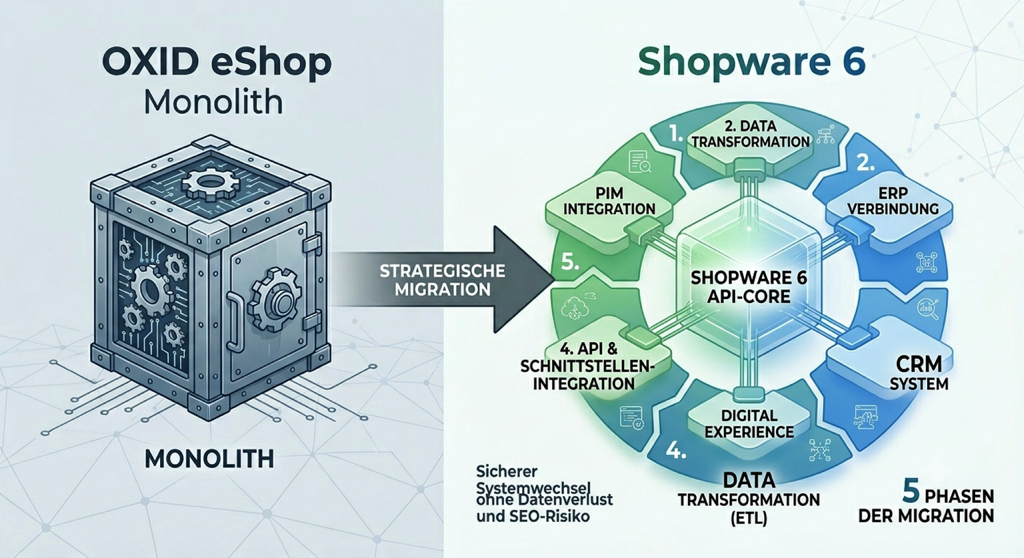
A migration from OXID to Shopware 6 is a complex undertaking that goes far beyond simply moving data. Our validated and proven migration process was developed specifically to provide CTOs and e-commerce managers with the greatest possible security and to effectively address concerns about data loss, downtime or SEO ranking declines. We ensure a reliable transition through precise planning, meticulous execution and comprehensive testing. Every step of our roadmap is designed to preserve data integrity and ensure a switch to the new shop system, allowing your online shop to remain operational without interruption. Our approach minimizes risks and maximizes the chances of a successful migration.
Phase 1: Analysis of Custom OXID Modules and Business-Critical Custom Developments
One of the greatest challenges when migrating from OXID eShop to Shopware 6 lies not in standard data such as products, categories or customer accounts, but in custom developments that have grown over many years. Many OXID systems have been extended over long periods with custom modules, ERP integrations, B2B extensions, individual pricing logic or direct core modifications. Frequently, complete technical documentation no longer exists, while individual developers or original service providers are no longer available.
Before every migration, we therefore carry out technical due diligence on all extensions and business processes. We analyze existing module chains, template overrides, database extensions and custom interfaces to ERP, CRM and PIM systems. The goal is complete transparency about which functions are actually business-critical today and how these can be represented within the Shopware 6 architecture.
In many projects, it becomes apparent that a significant proportion of historical extensions can be replaced by standard functions in Shopware 6. Functions that are still required are reimplemented cleanly and in an update-capable manner using custom plugins, API integrations or the Shopware Rule Builder. This avoids transferring technical legacy burdens and instead enables controlled modernization of the entire e-commerce infrastructure.
We pay particular attention to business-critical processes such as customer-specific B2B pricing structures, custom approval workflows, automated ERP synchronizations, special shipping logic or industry-specific product configurators. These functions are fully documented, tested and validated in a controlled staging environment before go-live.
This ensures that not only data is migrated, but that all business-relevant processes remain reliably available, high-performing and maintainable over the long term after the switch to Shopware 6.
Phase 2: Validated Migration of Customer Data, Order Histories & Variants
Which Data Can Be Migrated from OXID to Shopware 6?
The following overview shows the typical data areas that can be transferred as part of an OXID-to-Shopware migration. However, the actual scope always depends on your custom extensions, ERP integrations and historical data structures.
| Data Area | Migration Possible |
|---|---|
| Products | Yes |
| Variants | Yes |
| Categories | Yes |
| Customer Data | Yes |
| Password Hashes | Project-dependent |
| Order Histories | Yes |
| Tiered Prices | Yes |
| Customer Groups | Yes |
| Media | Yes |
| ERP Mappings | Custom |
After analyzing all business logic, modules and interfaces, the controlled transfer of operational data into the new Shopware 6 architecture begins. This includes not only product data, categories and media assets, but also customer accounts, order histories, variant structures, tiered prices, inventory levels and other business-critical data sets.
Particular attention is paid to the structural differences between OXID eShop and Shopware 6. Historically grown data models, custom attribute logic or extended product structures must be transformed into Shopware 6’s relational data model through precise entity mapping. Our ETL pipelines (Extract, Transform, Load) perform this task automatically and transparently.
All data sets are validated multiple times in isolated staging environments before go-live. We check data integrity, variant relationships, customer assignments, order histories, as well as the consistency of prices, tax rates and inventory levels. The final migration to the live system takes place only after successful technical acceptance.
The goal of this phase is not merely to transfer data, but to move all business-relevant information completely, consistently and maintainably into the Shopware 6 infrastructure for the long term.
Phase 3: Seamless SEO Protection Through Intelligent 301 URL Mapping
Typical SEO Migration Risks and Countermeasures
| Risk | Measure |
|---|---|
| Loss of Existing Rankings | Complete 301 redirect matrix |
| Crawling Errors After Go-Live | Technical SEO validation before launch |
| Loss of Indexed Product Pages | URL mapping at entity level |
| Incorrect Canonicals | Advance review of all canonical structures |
| Organic Traffic Losses | Monitoring in Search Console & Analytics |
A system change always carries the risk of visibility losses. To eliminate this risk, we create a complete 301 redirect matrix at entity level before go-live. Search engines such as Google are thereby redirected to the new Shopware 6 structure. The result: your rankings, backlinks and organic authority built up over years are fully transferred to the new system.
Phase 4: Interface Integration (ERP, PIM & CRM)
The efficiency of a modern e-commerce system depends significantly on its integration into the existing IT infrastructure. In this phase, we focus on connecting your new Shopware 6 shop to central enterprise systems such as ERP (Enterprise Resource Planning), PIM (Product Information Management) and CRM (Customer Relationship Management). Thanks to Shopware 6’s API-first architecture, these interfaces can be implemented flexibly and robustly. We develop tailor-made configurations and, where appropriate, use existing plugins to ensure a seamless flow of data between systems. This safeguards data integrity across all channels while optimizing internal business processes. Manual effort approaches zero.
Phase 5: Hypercare & Performance Hosting Through Managed IT Services
After the migration has successfully gone live, the hypercare phase begins, during which our expert team intensively monitors the performance and stability of your new Shopware 6 shop. This phase is crucial for quickly identifying and resolving any initial issues. At the same time, we offer first-class performance hosting through our managed hosting on our own high-performance infrastructure. This means that we not only provide the infrastructure, but also proactively ensure its optimization and security. Our managed hosting ensures minimal loading times, maximum availability and a highly scalable environmentthat is ideally equipped for the future growth of your online shop. Customers benefit from our 24/7 support and the certainty that their migrated Shopware shop always runs under optimal conditions.
Make Success Measurable: Performance Boost After Replatforming
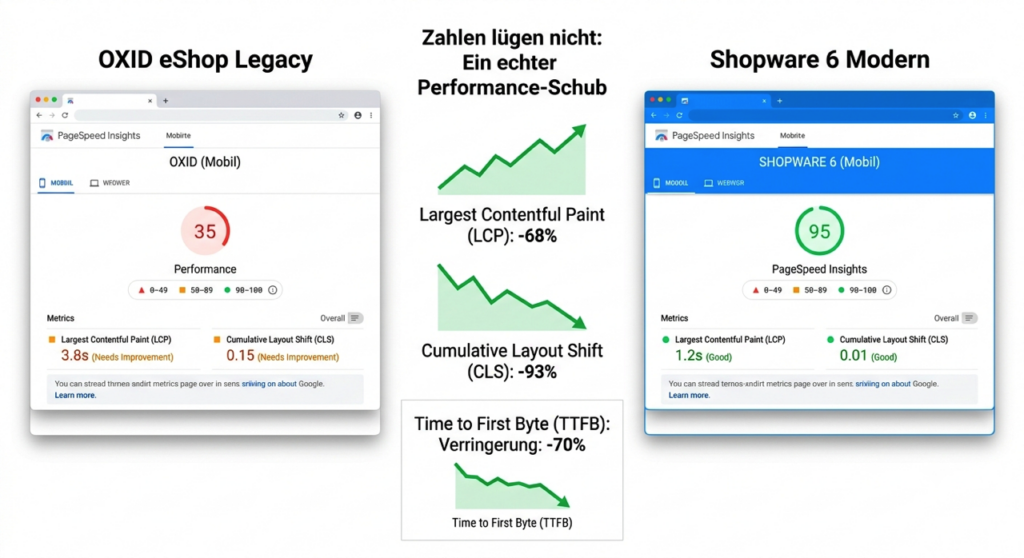
Replatforming from OXID to Shopware 6 is an investment that must translate into measurable success. From our experience, we know that switching to Shopware 6 not only lays the technical foundation for future growth, but also directly leads to a significant performance boost. This is reflected in a wide range of metrics, from improved loading times and greater usability to increased conversion rates and a sustainable improvement in your SEO visibility. Our detailed analysis before and after the migration allows us to document success transparently and comprehensibly. The successful migration therefore acts as a catalyst for an optimized customer journey and stronger customer loyalty.
Case Studies: Two Successful Migrations in Focus
After years of intensive use and custom extensions, many OXID-based B2B platforms reach their limits. The result: blocked updatability, high maintenance effort and rigid interfaces to ERP, CRM and PIM systems. Replatforming to Shopware 6 breaks up this historically grown complexity.
Shopware 6’s modern API-first architecture transfers historically grown custom developments into a maintainable long-term structure. Complex B2B requirements – such as customer-specific pricing logic, multi-stage approval processes or multilateral sales channels – can therefore be represented in a much more standardized way. This reduces ongoing operating costs, protects your IT investments and creates the technological foundation for future growth.
The following project excerpts from our agency show what this system change looks like in practice:
Example 1: International B2B Wholesaler (Electrical Engineering)
- Starting Point: Monolithic OXID shop with more than 100 historically grown custom modules and blocked updates.
- Solution: Consolidation of B2B approval processes in Shopware 6 Evolve Edition and integration with Microsoft Dynamics ERP via the API.
- Result: Reduction in time-to-market for new country shops by 70%; noticeable performance boost in the backend.
Example 2: Multi-Shop Setup in Manufacturing
- Starting Point: Complex customer-specific pricing logic in OXID that overloaded the database under high traffic.
- Solution: Replatforming to Shopware 6 Evolve using the integrated Rule Builder for complex B2B pricing matrices.
- Result: 45% faster API response times and reliable synchronization of more than 200,000 SKUs with the PIM system.
| Project | Starting Point | Solution | Result |
|---|---|---|---|
| B2B Electrical Engineering Wholesale | 100+ custom modules, limited updatability | Shopware 6 + Dynamics ERP Integration | 70% faster rollouts |
| Manufacturing | Complex pricing logic, high database load | Rule Builder + Shopware 6 Migration | 45% faster API response times |
Why HQ GmbH for OXID-to-Shopware Migrations?
Experience from Complex Replatforming Projects
For years, our teams have supported companies in technically consolidating historically grown e-commerce landscapes. Projects range from replacing legacy shop systems and modernizing custom ERP interfaces to international multi-store architectures with multiple sales channels.
Especially in environments involving OXID eShop, Shopware, Magento and custom-developed e-commerce platforms, companies often face similar challenges: historically grown custom developments, missing technical documentation, complex ERP integrations, outdated PHP versions or modules that can no longer be updated.
As part of replatforming projects, we analyze existing system architectures, document business-critical processes and develop migration strategies for products, customers, order histories, interfaces and custom business logic. The goal is not simply data transfer, but the controlled transition of all relevant business processes into a maintainable long-term Shopware 6 architecture.
Through close collaboration between developers, DevOps specialists and integration architects, technical risks can be identified early and minimized during migration. This creates a robust foundation for future internationalization, B2B processes, ERP integrations and scalable growth.
Experience with Complex Legacy Migrations
Our experience is not limited exclusively to OXID migrations. In recent years, we have supported numerous replatforming projects from historically grown e-commerce landscapes – including migrations from xt:Commerce, Magento, Shopware 3, Shopware 4 and custom-developed shop systems.
Migration projects involving historically grown shop systems are particularly demanding. In many companies, these systems were updated across versions over many years, supported by changing agencies and overloaded with countless plugins. Our practical experience shows that changes were often not implemented according to vendor specifications, leaving legacy burdens in the file system and orphaned data structures in the database – a condition in which standard migration tools fail.
In addition, there are usually proprietary ERP integrations, custom product data models or a complete lack of technical documentation.
Thanks to our 30-year presence as an agency in the market, our teams have analyzed, cleaned up and migrated countless complex legacy systems of this kind. We have already successfully transferred online shops that had been continuously developed in live operation since Shopware 3.x or even osCommerce and XT-Commerce. Where standard solutions failed, our e-commerce experts adapted the migration infrastructure programmatically so that precise data transfer and seamless interface integration became possible.
This experience helps us plan even complex OXID migrations in a structured manner, identify technical risks early and securely transfer business-critical processes into modern Shopware 6 architectures.
100% In-House Engineering by E-Commerce and Migration Experts
All migration, integration and development services are implemented by our permanent team of specialized developer experts at HQ GmbH. Because our developers not only master modern target systems such as Shopware 6 but also understand the deep database structures of decades-old legacy systems (such as OS- or XT-Commerce) from the ground up, all project know-how remains in one hand.
Through this complete in-house expertise – from ETL data cleansing to native API integration – we reduce communication losses, drastically accelerate troubleshooting and ensure seamless documentation of the new system architecture.
Our Own Managed Hosting Infrastructure
In addition to development itself, HQ GmbH supports companies in providing and scaling the technical infrastructure. For migration projects, we provide fully managed hosting environments that are precisely optimized for Shopware 6 workloads and continuously monitored by our DevOps experts.
Among other technologies, we use dedicated Redis object caching, Varnish HTTP caching and performance-tuned database and web-server clusters (NGINX/Kubernetes). This reduces Time to First Byte (TTFB) to a minimum and guarantees a fully managed system that remains completely stable even during traffic peaks.
ERP and API Specialists
Complex system landscapes require stable communication between the shop, ERP, CRM, PIM and other third-party systems. HQ GmbH develops and supports custom interfaces for ERP, CRM and middleware platforms.
These include integrations with SAP, Salesforce, Microsoft Dynamics and Sage, as well as custom-developed API architectures. The goal is a consistent flow of data between all systems involved and the avoidance of manual process steps.
Southern European Project Support Through Our Branch in Spain
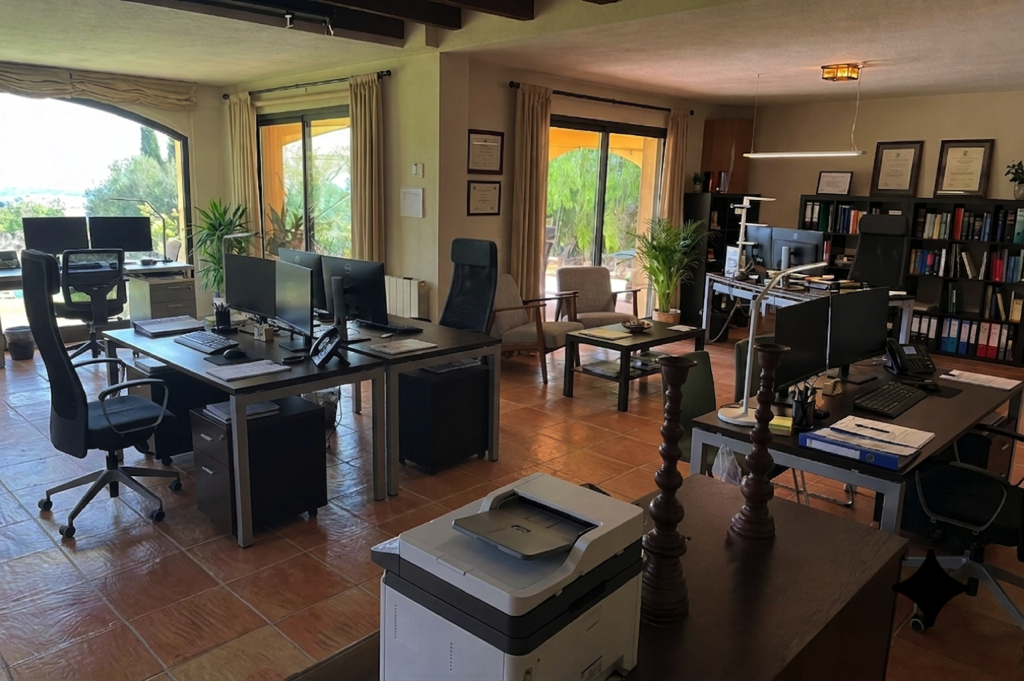
In addition to our main location in Germany, HQ GmbH supports Southern European e-commerce projects through its own branch in Spain. This enables us to support companies with pan-European sales structures, multilingual shop systems and cross-border rollout projects highly efficiently and directly on site.
Especially for international Shopware migrations, complex multi-store concepts and the technical consolidation of different e-commerce platforms, our customers benefit from short decision paths, local presence in the Southern European market and centralized, reliable project management according to familiar German quality and security standards.
24/7 SLA Support
Business-critical e-commerce systems require fast technical response times in the event of disruptions. HQ GmbH supports companies with individually agreed Service Level Agreements (SLAs) for operation, maintenance and troubleshooting.
Response time does not merely mean the automatic confirmation of a ticket, but the actual start of technical analysis by qualified developers. This enables disruptions to be narrowed down quickly and minimizes potential impacts on revenue, logistics and customer service.
Maximum performance, seamless data security and zero SEO risk.
30 Years of Project Experience
We have helped shape the evolution of e-commerce from the very beginning. Even highly orphaned or complex legacy systems are analyzed by our experts and transferred into modern structures without errors.
100% In-House Engineering
No anonymous subcontractors. All migration processes, API integrations and system architectures are implemented exclusively by our permanent developers in Germany and Spain.
Seamless SEO Protection
With our fully automated 301 redirect matrix at entity level, we intercept all old URL structures. Your rankings and organic visibility built up over years are fully preserved.
No Downtime
Your day-to-day business continues without restriction in the old OXID shop. Development takes place in isolation on staging systems. Only after a delta migration do we switch the domain during a low-traffic nighttime period.
Frequently Asked Questions About OXID-Shopware Migration (FAQ)
Will my Google rankings be preserved when switching from OXID to Shopware?
Yes, provided the migration is accompanied strategically. Our migration process is designed precisely to not only secure your existing SEO visibility, but also lay the technical foundation for future ranking gains. Through the 301 URL mapping described in Phase 3, we precisely redirect all old OXID paths. After go-live, our SEO team closely monitors Google Search Console in order to rule out indexing errors immediately.
Can highly customized OXID modules be transferred to Shopware 6?
Transferring highly customized OXID modules to Shopware 6 is a key issue because many OXID shops have tailor-made extensions and features developed over many years. OXID plugins cannot be transferred directly to Shopware 6 because the architectures of the two shop systems differ fundamentally. Shopware 6 is based on a modern API-first architecture, while older OXID versions often have a more monolithic structure. However, our experts analyze each custom OXID module in detail to identify its core functionality. In our experience, Shopware often already provides suitable functionality out of the box. If this is not the case, we either develop a corresponding tailor-made solution in Shopware 6, use existing Shopware plugins or adapt the functional scope so that your specific requirements are optimally represented in the new online shop. This ensures that you do not have to compromise on functionality after the migration and instead benefit from the advantages of the modern Shopware 6 architecture.
Will migrating from OXID to Shopware 6 improve my Core Web Vitals and Google visibility?
Yes, significantly. Search engines such as Google evaluate user experience (Page Experience) using the so-called Core Web Vitals as a hard ranking factor. Older, monolithic OXID installations often suffer from high Time to First Byte (TTFB), blocking JavaScript and outdated template structures that slow mobile loading times.
By switching to Shopware 6’s modern, lean architecture in combination with our specialized managed hosting infrastructure (including Redis and Varnish caching), we drastically reduce server response times. Your shop loads noticeably faster, which not only leads to better indexing and higher Google rankings, but also demonstrably increases your visitors’ conversion rate.
Why is your 30 years of market experience a security factor for our data migration?
Over the past three decades, our teams have actively accompanied the entire evolution of modern e-commerce. We know not only the modern API-first world of Shopware 6, but have understood and helped develop the architectures of early systems such as osCommerce or XT-Commerce from the very beginning.
This historical expertise is invaluable in complex migrations: we know exactly how data structures were built 15 or 20 years ago and where orphaned legacy burdens may be hidden in your OXID database. While purely standard agencies fail with such legacy data models, our core developers clean and transform this history without errors. Thirty years in the market means for you that we have almost certainly already successfully solved your type of IT chaos before.
What advantages does your branch in Spain offer me during an international Shopware migration?
Our presence in Spain is a central strategic advantage for companies entering or already operating in the Southern European market. International replatforming projects often fail not because of technology, but because of local specifics – such as country-specific tax logic, regional ERP peculiarities or language barriers when coordinating foreign teams.
Through our local branch, we combine familiar German project-management quality and data security with in-depth market knowledge in Southern Europe. For you, this means short communication paths, highly efficient cross-border rollouts and seamless technical localization of your new Shopware 6 system.
Who supports my migration project – do you work with subcontractors or nearshoring partners?
No, at HQ GmbH we rely 100% on in-house engineering. All architecture decisions, complex ETL data processes, API integrations and code optimizations are implemented exclusively by our own permanent developer experts in Germany and – where your Southern European expansion is concerned – our branch in Spain.
In enterprise e-commerce, shared responsibilities or outsourcing to anonymous subcontractors are an unpredictable security and quality risk. Through our permanent in-house team, we guarantee uncompromising code quality, maximum data security in accordance with GDPR standards and a well-coordinated project team that still knows your system inside out years after go-live.
Can we continue selling normally in the old OXID shop during the migration?
Yes, without restriction. Your day-to-day business continues without interruption in the existing OXID eShop throughout the entire migration process.
The actual migration, interface programming and all system tests take place in isolation on our protected staging and development environments. Only immediately before the actual go-live of the new platform do we perform a so-called delta migration. This automatically transfers only the data that has been added to the live system since the last data import (e.g. new customer accounts and orders from the last few days).
For the final system switch (switching the domain in DNS), we choose a low-traffic time window – usually in the early morning hours. Your live shop therefore remains continuously accessible and your customers experience no downtime.
Daniel Vogel
Daniel Vogel is the technical lead (Head of Development) at HQ GmbH. With his deep expertise in system architecture and Core Web Vitals, he leads the in-house development team on demanding e-commerce projects. His specialist area is complex replatforming scenarios, particularly the secure migration from Magento or Shopify to future-proof Shopware platforms.
In addition, he is the operational lead for technical emergency migrations and crisis management. When existing systems collapse under load or outdated code structures block growth, he designs and implements robust, high-performance architectures to get them back on track.