From Plentymarkets (PlentyONE) to Shopware 6: Why the System Change Is Crucial for Growing Mid-Sized Companies

In our work at HQ GmbH, as a certified Shopware agency with proven experience in complex e-commerce projects, we have supported countless online shops and gained deep insights into how a wide range of platforms work.
HQ GmbH is an owner-managed digital agency focused on enterprise e-commerce, custom software development and scalable digital platforms. The company develops and operates complex e-commerce systems based on various technologies such as Shopware 6, Magento, Shopify, WooCommerce, TYPO3, WordPress and custom software solutions. The focus is on technical architecture, migrations, integrations, performance optimization and stable long-term digital platforms for demanding companies.
Thanks to our early experience with SaaS models since 2001 and our specialization in fail-safe high-performance hosting infrastructures since 2002, we apply particularly high standards to system architecture, stability and scalability.
Especially with growing companies and complex e-commerce projects, we repeatedly encounter technical challenges that can make agile development, maintainability and stable operation more difficult. In this article, Lukas Ehrenberg, Senior Shopware Developer & Integration Architect and expert for Shopware 6, Odoo integrations & ERP migrations at HQ GmbH, explains the practical experience gained in PlentyONE projects and why switching der Frontend- und Shop-Architektur to Shopware 6 can represent a strategic alternative for certain scenarios.
Why HQ GmbH Can Support You with a PlentyONE-to-Shopware 6 Migration
As a certified Shopware agency with experience in complex enterprise e-commerce projects, we support companies with the technical evaluation, planning and implementation of platform changes.
Lukas Ehrenberg, Senior Shopware Developer & Cluster Specialist at HQ GmbH, brings his practical experience from complex Shopware 6 migrations and enterprise infrastructures to the evaluation and technical implementation of PlentyONE replacements.
Our experience includes complex data migrations, API-based integrations, custom interface solutions and the technical preparation of a stable Shopware 6 infrastructure. Thanks to our own hosting expertise, we additionally support companies in building a scalable and high-performance operating environment for modern e-commerce systems.
Our Expertise: Why We Understand PlentyONE Down to Its Core
From practice: > Our recommendation for the switch is not based on theory alone. In the past, we ourselves designed highly complex Plentyshops (based on Ceres and PlentyLTS) from the ground up and implemented deep PlentyERPintegrations for multichannel commerce.
It is precisely from this intensive hands-on development work that we know the system’s limitations – for example API restrictions, caching limits or closed cloud structures – down to the smallest detail. Because we know PlentyONE’s architecture inside out as integrators, we can now design migration paths and ERP interfaces to Shopware 6 that address exactly where growing online retailers reach their limits.
Are you currently considering switching from PlentyONE to Shopware 6?
We analyze your existing system architecture without obligation and show you secure migration paths.
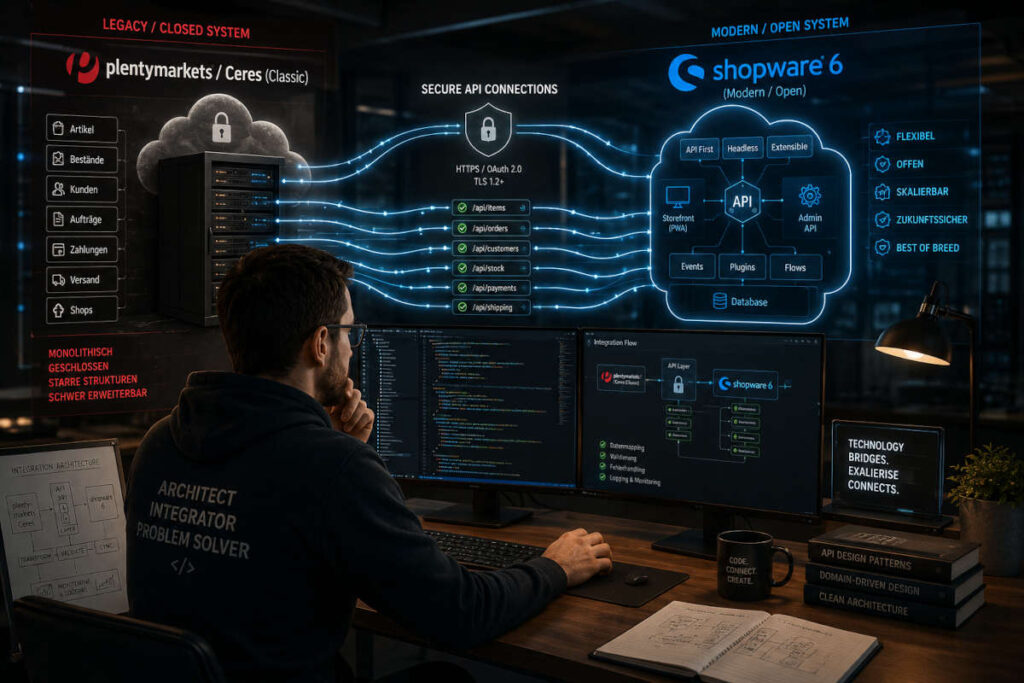
Practical Audit: Architecture Assessment for Demanding Project Requirements
Based on extensive project implementations (including Q3/2025), our lead developers analyzed the architecture of PlentyONE. The assessment is based on practical development, integration and migration requirements from real e-commerce projects. In the context of highly scalable, agile e-commerce projects, specific structural characteristics emerge that must be assessed strategically for complex requirements:
1. Development Processes: Cache Management & Deployment Cycles
- Management of Cache Invalidations: In specific project environments, limitations on manual cache clearing were observed that can slow iterative development processes. When quotas are exhausted during intensive project phases, this often requires additional coordination with support, which can interrupt agile workflows.
- Compilation and Waiting Times: The deployment process using separate tools and subsequent cloud compilation is structurally inherent. In practice, this means that local code changes can take several minutes, depending on scope and compilation process, before they are available for testing.
2. Infrastructure Access: Limited Technical Transparency
- Managed Cloud Models: In fully managed cloud models, the focus is on platform operation by the provider. For teams that require deep infrastructure access, their own debugging processes or custom deployment workflows, this can mean restrictions in the development process.
- Code Forensics and Support Coordination: For in-depth code forensics and custom performance analyses, restricted access to core systems, servers and log files can require additional coordination. In the event of critical system errors, this creates greater process dependency on the response times of vendor support.
- Documentation and UI: In complex projects, it became apparent in individual cases that backend structures and developer documentation require additional familiarization time or make it necessary to consult community forums.
3. Frontend Architecture: Complexity of Theme Customizations
- Custom Frontend Adjustments: Working with proprietary themes (such as Ceres or PlentyLTS) requires careful planning. To avoid permanent overwriting of custom modifications in the child theme by core updates, greater complexity often arises in the code structure in practice (e.g. through extensive CSS or JavaScript specificity).
- Visual and SEO-Specific Modifications: Additional adjustments may be necessary for custom SEO requirements. In practice, this was evident, for example, when modifying title suffixes (removing standardized appendages in the theme), which sometimes required renewed manual review and adjustment after system updates. Deep UI/UX changes also occasionally encounter limitations within the predefined theme boundaries.
4. Scaling and Test Environments: Plugin Management
- Resources for Test Environments: System-side limitations on the maximum number of plugin sets can restrict parallel development. In projects, existing environments sometimes had to be deleted in order to free capacity for new test sets.
- Updates of Third-Party Extensions: A key architectural aspect is update behavior for critical third-party extensions (e.g. in the payment sector). Such system-relevant updates often cannot be tested completely in isolation in a single plugin set because they may immediately affect the entire shop and all environments. This places increased demands on risk management before every update process.
The Breakthrough: How Shopware 6 Unlocks New Potential
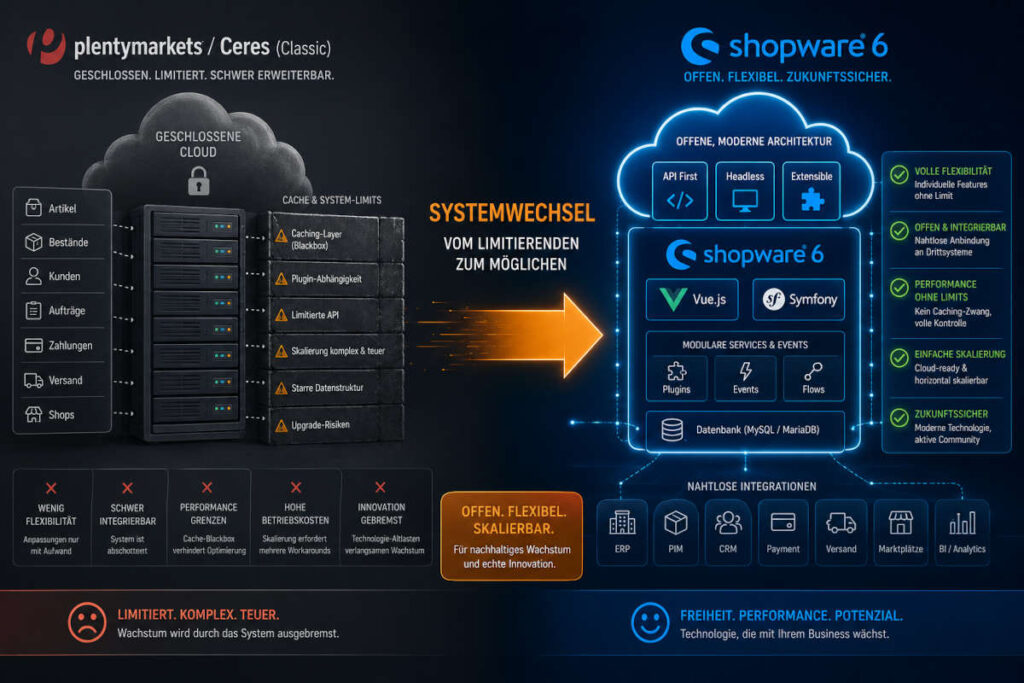
Open Source Based on Symfony and Vue.js
For us, the decisive factor was choosing a future-proof platform that offers us greater control. As a genuine PlentyONE alternative, Shopware 6 provides exactly that. Here is the objective technological comparison for decision-makers:
| Technology Aspect | PlentyONE (Legacy System) | Shopware 6 (Target System) |
|---|---|---|
| System Type | Closed-source & managed cloud platform | Open-source solution |
| Architecture Foundation | Proprietary (Ceres / PlentyLTS) | Symfony & Twig (storefront), Vue.js (administration) |
| Debugging Access | Restricted infrastructure access | Full access to core, system logs and database – depending on hosting model |
| Deployment Speed | Dependent on cloud compilation | Modern development processes with fast feedback cycles |
This transparency in Shopware 6 is a decisive advantage when we implement and operate highly available systems for upper mid-sized companies.
Lean Local Infrastructures and Fast Feedback Cycles
With Shopware 6, we deliberately rely on native local development infrastructures without Docker overhead. Even if the difference may seem minimal, dispensing with container structures gives us further improved performance in the development environment. For the workflow, this means reduced waiting times for compilation and uploads. Instead, we benefit from modern development processes with local development environments and fast feedback cycles in which many code changes are visible immediately in the browser without detours.
Modern Infrastructure with Symfony and Vue.js
Shopware 6’s foundation with the established Symfony framework provides us with a clean, extensible basis for complex logic. In the frontend, Vue.js enables high-performance, responsive user interfaces. As someone responsible for complex clusters, I greatly value the extensive control over the infrastructure. We can configure servers individually to achieve measurable, scalable results in e-commerce. Shopware 6 can also be synchronized seamlessly with ERP systems thanks to modern API architectures.
Our Proven Migration Process: Data Integrity and Zero Downtime
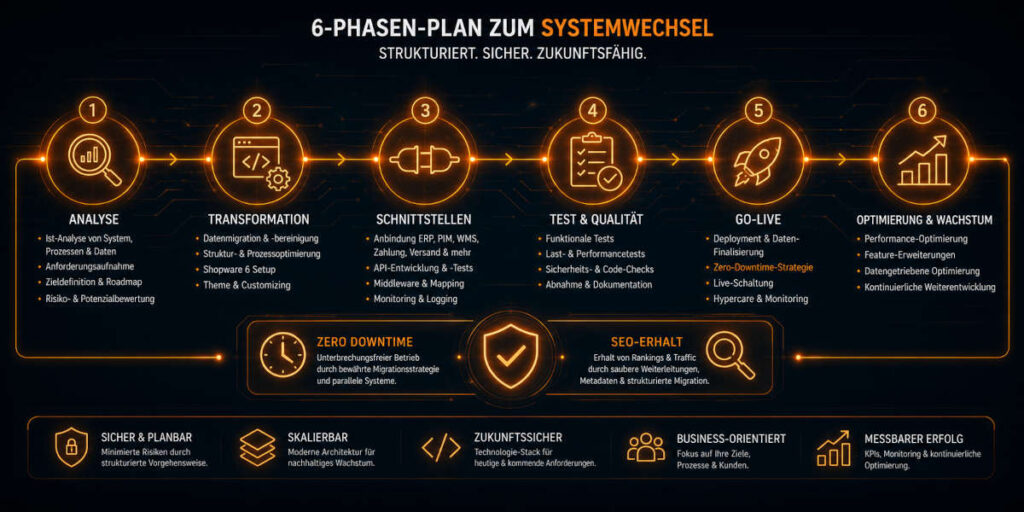
A system migration in the mid-sized sector requires more than simply exporting and importing CSV files. Our focus in a Shopware 6 migration is consistently on absolute data integrity and the principle of “Zero Downtime.” As experts in data-intensive system transformations, we ensure through deep integration of the systems that business operations continue undisturbed throughout the entire changeover.
Practical example: > For a growing online shop with a complex ERP integration, our initial focus was entirely on the data model, interfaces and strict preservation of SEO. Only after this in-depth analysis and securing all entities did the actual technical migration take place. This approach guaranteed a smooth transition without visibility losses.
Especially when integrating and replacing multichannel ERP systems such as PlentyONE, we rely on precise control of asynchronous data flows. This guarantees that inventory and product data are synchronized in real time without violating critical API limits. Our primary goal is error-free replatforming of complex legacy systems, in which historical customer data, order histories and SEO rankings are securely transferred into the new, future-proof Shopware 6 environment.
1. System Analysis & Architecture Assessment
Before the actual migration, we analyze the existing system landscape:
- Data structures and custom adaptations
- existing workflows
- shop templates and frontend customizations
- ERP, PIM, CRM and payment interfaces
- performance and scaling requirements
The goal is not only to eliminate existing problems, but to build an optimized Shopware 6 architecture.
2. Data Migration & Data Model Transformation
A professional migration requires more than transferring data records. Among other things, we review and transfer:
- Products and variants
- Categories and properties
- Customer and order data
- SEO-relevant URLs and redirects
- Media and product information
The existing data model is adapted to the Shopware 6 structure in the process.
3. Interface Review & System Integration
Mid-sized shops rarely consist of the shop system alone. We therefore analyze all relevant integrations:
- ERP systems & merchandise management
- Payment providers & shipping service providers
- Marketplaces
- custom APIs and middleware solutions
The goal is a stable system architecture without critical dependencies.
4. Performance Concept & Scalable Infrastructure
Shopware 6 makes it possible to tailor the infrastructure to individual requirements. We consider:
- Server architecture & caching strategies
- Database optimization & loading times
- Scaling during traffic peaks & monitoring concepts
Especially for ambitious projects, the technical foundation determines long-term stability.
5. Go-Live Planning & Controlled System Change
A shop change must be predictable and low-risk. This includes:
- final data migration & technical acceptance
- SEO checks & redirect verification
- performance tests & controlled switchover
This prepares the transition from PlentyONE to Shopware 6 without unnecessary downtime.
6. Monitoring & Further Development After Migration
After go-live, the actual optimization phase begins. We monitor:
- technical stability & performance metrics
- interfaces & conversion-relevant processes
- future extensions
A successful migration does not end with launch, but forms the foundation for sustainable further development.
Alternative if PlentyONE Is Retained as the ERP System
Points 1–6 remain, although in modified form. If the PlentyONE ERP system is retained, we recommend using a PlentyONE-to-Shopware connector.
Using PlentyONE as the ERP system generally requires optimizing the requests that Shopware sends to PlentyONE for cost reasons (API limit or disproportionately high costs for increasing the API limit).
In our experience, challenges can also arise from time to time, for example because Plenty does not “know” certain Shopware functions such as properties (only indirectly and with limitations) or Custom Products, or when PlentyONE updates disable customers’ ERP systems.
Thanks to our experience, we have already been able to solve these challenges successfully for our customers on multiple occasions.
Our Conclusion: A Risk-Free System Change Instead of Permanent Workarounds
From my practical experience as a developer with extensive experience in Shopware 6 migrations, one thing often becomes clear: those looking for a powerful PlentyONE alternative frequently recognize that remaining in a closed environment can inhibit growth for expanding retailers over the long term. Permanent workarounds and limited control tie up valuable resources.
A clean migration cutover to an open-source platform such as Shopware 6 is, in our experience, often the economically and technologically superior decision. As a specialized Shopware migration agency we support exactly this step. A clean Plenty-to-Shopware migration resolves acute technical hurdles. To make this process as secure as possible for shop operators, we offer a structured system change at no cost We ensure a changeover without hidden setup fees, handle the technical implementation and create a stable, future-proof foundation for your e-commerce success.
Ready for the Strategic System Change?
Benefit from our migration framework for growing retailers.
✔ Zero Downtime
Your sales continue undisturbed throughout the migration. We synchronize data in real time.
✔ SEO Preservation
No visibility losses thanks to seamless redirect mapping and metadata migration.
✔ High-Performance Hosting
We provide the scalable server infrastructure so Shopware 6 can deliver its full performance.
✔ System Change at No Cost
We handle the technical implementation without hidden setup fees for a clean start.
Frequently Asked Questions About PlentyONE → Shopware 6 Migration (FAQ)
Why do retailers switch from PlentyONE to Shopware 6?
Many mid-sized retailers switch when they need greater control over software architecture, flexible extensibility and uncompromising performance that is often limited by the closed-source structure of the legacy system.
Why choose HQ GmbH as a partner for migrating from PlentyONE to Shopware 6?
A system change is a matter of trust. As a Certified Shopware Partner, we combine technological excellence with a clear philosophy for mid-sized companies:
In-Depth Experience: We know not only Shopware 6, but have also worked with the architecture of PlentyONE and PlentyERP down to the core ourselves for years.
Personal Support: We do not put anonymous ticket systems between you and us. You work directly with dedicated, highly qualified contacts on equal footing.
Satisfaction Instead of Contractual Lock-In: We do not bind customers through rigid contract terms, but exclusively through outstanding performance and measurable results.
24/7 Support: E-commerce is business-critical and downtime costs real money. That is why our technical support is available around the clock to protect your revenue.
How long does a migration from PlentyONE to Shopware 6 take?
The duration is highly individual and depends on the existing data model, the number of interfaces, ERP integrations and specific custom developments. As a rule, for growing online shops we plan a structured transition over 1–2 months to ensure absolute security.
If PlentyONE is retained as the ERP, the migration can also be faster because products from PlentyONE ERP can be transferred to Shopware through special interfaces with corresponding mapping.
What happens to products, customers and orders?
In professional migrations, the complete data models are analyzed and transformed in advance. Products, customer histories and ongoing orders are transferred securely and in compliance with data-protection requirements into the new Shopware 6 system.
Can PlentyONE be retained as the ERP while using Shopware 6 as the shop?
Yes, this is a common scenario. PlentyONE then continues to operate as the ERP in the background, while Shopware 6 handles the frontend and shop logic.
For this purpose, we set up dedicated connectors and optimize API requests to avoid limits and unnecessary costs for increasing API limits.
What are the risks of a Shopware 6 migration?
The greatest risks are data loss, declines in SEO visibility and API outages. Through our structured 6-phase plan and the zero-downtime principle, we minimize these risks to a technically controllable minimum.
Which data can be migrated?
In principle, all structured data can be migrated: products including variants and properties, categories, customer data, order histories, media such as images and videos, as well as SEO-relevant metadata and URLs.
How are SEO rankings preserved?
Preserving SEO has the highest priority. We create exact 301 redirect mapping from all old URLs to the new Shopware structures and migrate meta titles, meta descriptions and relevant content structures so search engines can process the change as seamlessly as possible.
Which interfaces need to be checked?
We check all existing connections: ERP systems, merchandise management, PIM and CRM systems, payment service providers, shipping service providers, and integrations with external marketplaces such as Amazon or eBay.
Is migration possible without shop downtime?
Yes. By building the new Shopware 6 environment in parallel and performing a final, controlled data synchronization shortly before go-live, the interruption can be reduced to the technically necessary minimum. Sales continue largely without interruption during the migration.
Lukas Ehrenberg
Lukas Ehrenberg is HQ GmbH’s operational spearhead when it comes to complex, high-volume e-commerce infrastructures. Across numerous projects, he is responsible for the technical implementation of extensive ERP migrations — particularly the transition from legacy systems such as PlentyONE to modular platforms such as Odoo. Combined with his deep Shopware expertise, he builds scalable enterprise infrastructures. His extensive hands-on experience makes him the primary point of contact for brands seeking risk-free, data-secure and downtime-free replatforming.
As the technical administrator of a highly available enterprise Shopware cluster with more than 14 servers, he has mastered load balancing and system stability in high-frequency environments. His particular technical expertise lies in the architectural realignment of e-commerce ecosystems: He combines in-depth knowledge of secure data extraction from restrictive systems (such as the PlentyONE REST API with strict rate-limit optimization) with high-performance, asynchronous integration into modern ERP solutions such as Odoo. This enables him to ensure seamless system transitions even at the highest transaction volumes.