Shopify to Shopware Migration: Strategic Replatforming for Growing D2C and B2C Brands
Die strategische Entscheidung zur Migration von Shopify zu Shopware 6 stellt für expandierende D2C- und B2C-Marken im gehobenen Mittelstand einen notwendigen evolutionären Meilenstein dar. Dieser Prozess ist kein reiner Plattformwechsel, sondern eine fundamentale architektonische Neuausrichtung. Er ermöglicht es Unternehmen, die regain complete data sovereignty over their system landscape and establish an update-capable, relational foundation for international growth. A precise systemic analysis of the existing infrastructure is required to minimize operational risks during the change and maximize the Return on Investment (ROI) of the replatforming initiative. As part of this transformation, a targeted Shopware agency change is the primary tool for securing the transition at process level.
Why Expanding Online Shops Switch from Shopify to Shopware 6
The functional restrictions of Shopify and Shopify Plus’s closed SaaS ecosystem create an incalculable technological glass ceiling for ambitious retailers in the scaling phase. Rigid checkout restrictions in the monolithic core, forced dependence on proprietary payment gateways and incomplete internationalization logic progressively inflate operational Total Cost of Ownership (TCO). This closed-source infrastructure inhibits business agility in enterprise environments and blocks the implementation of highly specific B2B and B2C business processes.
📊 Technical and Commercial System Comparison: Shopware 6 vs. Shopify
| Comparison Criterion | Shopware 6 (Rise / Evolve / Beyond) | Shopify / Shopify Plus |
|---|---|---|
| License Model & Fees | Predictable, fixed revenue bands (GMV classes); no ongoing transaction-based fees. | Fixed monthly core costs plus percentage-based revenue commissions on every single sales day. |
| Payment Providers (Payments) | Free, vendor-independent choice of all gateways (Mollie, PayPal, Adyen) without artificial penalty fees. | Forced third-party penalty fees (up to 2.0%) when the in-house *Shopify Payments* is not used. |
| Data Sovereignty & Code Access | Complete data sovereignty; unrestricted access to the core source code and the entire relational database. | Closed SaaS silo; no direct server or database access, heavily restricted core modifications. |
| B2B & Wholesale Features | Natively integrated in the core standard (B2B Suite, customer-specific pricing matrices, catalog and login restrictions). | Heavily limited for mid-sized companies; permanently requires costly, error-prone third-party apps on recurring subscriptions. |
| API & Synchronization Limits | Unlimited API integrity; high-performance, direct real-time integration with complex ERP, PIM and merchandise-management systems. | Restrictive, cloud-based API rate limiting (e.g. 40 calls/min); acute risk of data backlogs during large ERP synchronizations. |
| Financial Accounting (DATEV) | Highly flexible, process-efficient export options; DATEV-optimized CSV can be created directly and without additional costs. | Dependence on external SaaS middleware; for growing shops this leads to several hundred euros in additional costs per month. |
| Checkout Flexibility | Unlimited, update-capable adaptation of custom sales logic via the native Shopware Rule Builder directly in the system. | Rigid checkout infrastructure; forced, unannounced vendor updates with risks to logins and existing app workflows. |
| URL & SEO Structure | Completely free, logical design of the directory hierarchy for maximum cluster and keyword visibility. | Rigid path specifications enforced by the cloud system (e.g. fixed prefixes such as `/products/`) that block clean enterprise SEO. |
The B2B Deficit: Limits of the Shopify Ecosystem in Wholesale
In demanding mid-sized B2B environments, Shopify’s infrastructure systematically fails to natively represent customer-specific pricing and discount matrices, complex tier logic and bidirectional real-time ERP synchronization. These business-critical B2B workflows can usually only be simulated in the cloud environment using fragmented, error-prone third-party apps. This creates serious code debt in the frontend, increases the risk of outages and generates uncontrollable dependencies on external SaaS providers. By contrast, Shopware 6 represents these complex B2B features natively in the standard system , ensuring high-performance, update-capable wholesale management and eliminating interface friction.
The Commercial Reality: Revenue-Dependent Fees vs. Predictable TCO
A major economic factor when comparing platforms is Shopify’s transaction-based fee structure. When scaling into seven- and eight-figure annual revenue, percentage-based transaction fees (especially additional fees when not using Shopify Payments) noticeably reduce operating margins. This creates a cost structure that grows with revenue instead of remaining predictable.
Shopware 6 takes a different approach: a predictable licensing model divided into fixed revenue bands (GMV classes). Within your revenue band, your license costs remain stable – regardless of how many transactions you process or which external payment providers you connect. This transparent cost structure protects growing brands against unforeseeable cost increases during ongoing seasonal business.
This commercial difference is also evident in downstream operational processes – such as DATEV exports for financial accounting. For growing online shops, error-free and fast transfer of booking data to the tax advisor is business-critical. Shopware 6 already provides a flexible CSV export in the core for this purpose. Standardized mappings can be used to create an export that can be imported directly into DATEV – even for complicated structures with numerous different VAT rates. Those who prefer the convenience of a plugin that can be flexibly adapted at any time instead of maintaining mappings manually can use paid DATEV plugins from the store.
With Shopify, however, the data structures reside in the closed cloud system outside direct access. Anyone requiring a legally compliant DATEV interface there depends on external SaaS middleware providers, which often charge according to the number of orders. As transaction volume increases, these can cost several hundred euros per month – in addition to the transaction fees that already exist. What burdens margins at Shopify as permanent additional overhead can be solved in Shopware 6 with the free core export or, alternatively, a licensed extension, without dependence on external SaaS middleware.
The Technical Migration Model: Securing Data Sovereignty and API Integrity
Switching from Shopify to Shopware 6 gives companies complete data sovereignty and frees them from dependence on proprietary server infrastructures. While Shopify’s closed cloud silo denies access to core databases and heavily restricts system customizations, Shopware 6 provides an open, highly flexible API-first architecture. This enables the IT department to control and design API integrity to downstream systems completely independently. Transferring the system landscape into a standards-compliant PHP ecosystem (Symfony/Vue.js) reduces technological operating risks and increases the company’s adaptability.
Cloud Extraction via REST API and Structured Data Mapping
The database-level core task of the platform change lies in the controlled extraction of all data entities from the closed Shopify cloud. In daily project practice for growing shops, the technological restriction of the proprietary SaaS model becomes apparent here: Shopify’s restrictive API rate limiting protects the platform from overload, but regularly leads to massive data backlogs as data volumes increase.
With REST Admin limits using a bucket of 40 calls and a refill rate of 2 requests per second on the standard plan (or 4 requests per second with Shopify Plus), the cloud infrastructure blocks conventional synchronous database exports.
As a specialized engineering team, we already know these system limits in depth from integrating and optimizing SaaS ERP systems. In the past, we have repeatedly carried out extensive custom programming for our customers in order to intelligently consolidate complex requests in the background and comply with the specified request limit.
We apply exactly this practical experience to Shopify migration: to rule out business-threatening timeouts or incomplete data transfers, we use highly optimized ETL pipelines (Extract, Transform, Load). These pipelines control data extraction through intelligent throttling, use dedicated caching layers and enforce querying via the Shopify GraphQL API in order to consistently avoid inefficient overfetching from REST endpoints at code level.
The extracted product catalogs, historical orders and encrypted customer master data are then subjected to automated cleansing. Critical entity mapping precisely transforms these data sets into Shopware 6’s normalized, relational data model.
Checkout Stabilization: From a Rigid System to Custom Sales Logic
Migrating from Shopify to Shopware 6 offers decisive strategic advantages in checkout stabilization and user security. A central risk of Shopify’s closed cloud model is absolute dependence on unforeseeable core decisions by the vendor. When Shopify enforces architectural changes – such as discontinuing the classic customer login in favor of new Customer Accounts – growing shops no longer have a choice. New shops are forced to use the new system even when existing B2B workflows, login restrictions or downstream interfaces are disrupted as a result. Rolling back to a stable, proven version is impossible in the cloud infrastructure.
This is exactly where replatforming delivers maximum leverage through the superior flexibility of the Shopware Rule Builder. Unlike Shopify’s restrictive checkout infrastructure, which blocks deep interventions in the cart lifecycle, Shopware 6 enables native, unlimited configuration of custom sales, shipping and payment logic. Complex country-specific tax rates, dynamic freight-cost calculations or exclusive B2B conditions are processed directly in the core system without dependence on error-prone Shopify apps. This sustainably stabilizes server performance in checkout, protects the system against forced vendor changes, eliminates additional transaction fees and maximizes the conversion rate.
Typical Challenges in Real Shopify Migrations

Real migrations out of the Shopify cloud are characterized by complex systemic hurdles. The fundamental divergence of data structures – especially when mapping deeply nested product variants and hidden marketing automations – requires absolute DevOps expertise. A business-critical focus lies on the error-free transfer of all SEO-relevant master metadata (such as meta titles, descriptions and canonical paths) in order to categorically rule out a collapse in organic visibility in search results. Without a precise, vendor-compliant understanding of the system, incompatible API mappings in the target system inevitably lead to information loss and interface failures in merchandise management.
Three recurring practical examples illustrate in detail these systemic challenges that repeatedly present our engineering team with architectural tasks in mature projects:
- The nesting of metafields and unstructured data arrays
Shopify has a very flat product structure in the core. Growing shops therefore inevitably move additional B2B specifications, technical data sheets or specific attribute certificates into so-called Shopify Metafields. Because many third-party apps write these fields into the cloud as unstructured JSON strings, a simple API export without cleansing leads to unformatted code debris in the target system. During the transformation process, these arrays must be broken apart algorithmically, cleaned and transferred precisely into Shopware 6’s relational property and custom-field system in order to preserve frontend filterability. - The ID Chaos of Flat Variant Architectures
At database level, Shopify often treats products and their variants on a single, flat level, where each selection option is maintained as an isolated row with its own ID. Shopware 6, by contrast, strictly requires a hierarchical parent-child relationship (a main product to which variants are assigned as logical children). Without an upstream aggregation pipeline that mathematically consolidates these flat Shopify structures exactly and generates artificial parent IDs, product and image assignments collapse in the backend of the new store after import. - Loss of B2B Credit and App-Based Discount Tiers
Many retailers use external apps in the Shopify cloud to manage customer credit (Store Credit), loyalty points or specific B2B discount codes. This business-critical data lies outside standardized Shopify core exports and is often encrypted in the databases of the respective app vendors. Without separately accessing these app APIs and synchronously transferring credit balances via delta migration into the Shopware B2B Suite on the day of go-live, there is a risk of massive data loss that can immediately overwhelm customer support.
SEO Protection: URL Migration Without Loss of Organic Visibility

Seamlessly protecting Google rankings is the commercially most critical criterion in replatforming. Shopify enforces a rigid, search-engine-unfriendly URL structure in the source code that mandates inflexible directory prefixes such as /products/ or /pages/ . Shopware 6 provides complete freedom in search-engine optimization. To prevent an SEO collapse, we create a seamless, single-step 301 redirect matrix. Every historical Shopify URL is mapped mathematically precisely to the new, optimized Shopware paths. This prevents painful 404 errors, protects Googlebot’s crawl budget and transfers the full historical link authority to the new domain. Canonical tags and hreflang structures in international multistore setups are fully revalidated at code level in order to rule out traffic losses and sustainably increase organic visibility after the relaunch.
Zero-Downtime Go-Live: Synchronous Delta Sync for Orders
The requirement for a true zero-downtime go-live for high-volume B2C and D2C platforms tolerates no compromises in data integrity. To rule out a revenue standstill on the day of the switch, we build the new Shopware 6 infrastructure in complete isolation on our high-performance servers as a parallel staging system. While the legacy Shopify system remains online and untouched for your customers, we perform a synchronous delta sync in the hours before release. This automated ETL pipeline isolates exactly the data sets (new orders, customer registrations, address changes) whose timestamps are later than the initial main import and writes them into the new backend in real time. After the global DNS TTL is reduced, the IP switch takes place silently worldwide in the background – without data loss and without interruption to your ERP or logistics interfaces.
When Switching from Shopify to Shopware 6 Pays for Itself Economically

For high-revenue online brands, the initial migration costs generally pay for themselves within 12 to 18 months. This excellent Return on Investment (ROI) results primarily from the immediate elimination of percentage-based revenue commissions and savings on exploding app subscriptions, which make up an inefficient share of Shopify’s operational TCO. Even Shopify Plus often proves to be a commercial dead end during the growth phase due to high monthly fixed costs and limited customization rights. Shopware 6 establishes a transparent licensing model, consolidates complex workflows natively in the standard system and sustainably frees your company from the financial restrictions of proprietary cloud systems. To secure internal management approval, it is advisable to also review our transparent breakdown of Shopware agency change costs.
Why HQ GmbH for Shopify-to-Shopware Migrations?
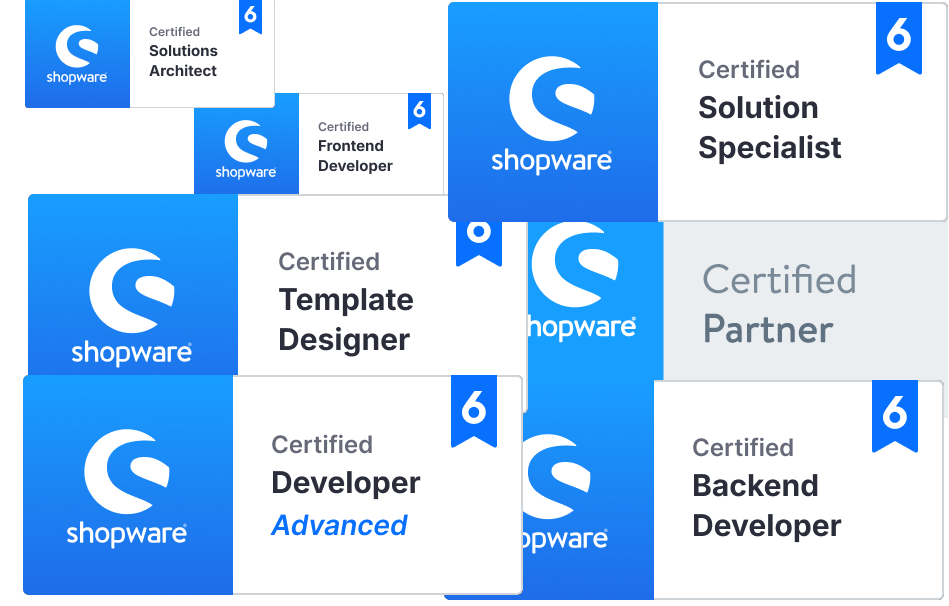
A successful migration from Shopify to Shopware 6 requires far more than a technical data import. In mature e-commerce systems, product data, customer accounts, order histories, ERP integrations, SEO signals and custom business processes must be transferred into the new system architecture in a controlled manner.
HQ GmbH supports companies in complex replatforming projects with a focus on data integrity, SEO security and long-term scalability. Our engineering team has experience migrating different shop systems as well as developing custom ERP, CRM and middleware integrations.
The focus is not merely on platform migration, but on the strategic evolution of the entire e-commerce infrastructure. The goal is a high-performance, update-capable and economically scalable Shopware system that reliably supports future requirements.
Before every project, we analyze existing data structures, interfaces, SEO risks and operational dependencies in detail. On this basis, an individual migration plan is created with clearly defined milestones, testing phases and a controlled go-live process.
Five Pillars of Our Migration Projects
Certified Shopware Partner & In-House Development
ETL processes, data migrations, interfaces and custom extensions are implemented by our internal development team. This keeps know-how, responsibility and quality assurance within one central project team.
Our Own Hosting and Infrastructure Expertise
In addition to development, we support companies with the architecture, hosting and performance optimization of Shopware systems. This includes Redis, Varnish and server-side caching concepts for high-performance shop environments.
Experience with Complex System Migrations
We support replatforming projects from Shopify, Magento (Adobe Commerce), WooCommerce and other e-commerce platforms. Data quality, process stability and long-term maintainability are central priorities.
ERP, CRM and API Integrations
Our developers implement custom interfaces and integrations with ERP, PIM and CRM systems such as SAP, Microsoft Dynamics, Sage or Salesforce. The goal is stable and traceable data communication between all systems involved.
Support and Long-Term Assistance
After go-live, we support our customers with the operation, further development and error analysis of their Shopware systems. Depending on the project scope, individual service and response times can be agreed.
Prefer a direct conversation with an expert? Get in Touch Directly.
FAQ on Migrating from Shopify to Shopware 6
Which data can be migrated?
Using our fail-safe ETL pipelines, we transfer all business-relevant core entities without loss of information.
The following data can generally be transferred:
Product data: Product names, descriptions, SKUs, prices, inventory, manufacturers and attributes.
Categories & variants: Product structures, category names and trees, as well as your product variants.
Media data: Product images, description images and documents.
Customer data: Names, email addresses, addresses (billing and shipping address).
Order history: All previous orders, invoices, order status, as well as linked customer and product data.
Discounts & vouchers: Active voucher codes and discount campaigns.
What cannot be transferred directly?
Customer passwords: For data-protection reasons, these cannot be exported. Your customers must request a new password when making their first purchase in the new Shopware shop.
Design & templates: The frontend cannot simply be copied. Shopware uses its own template system, so the design must be adapted to your corporate identity.
Apps & extensions: Shopify-specific apps do not work in Shopware. Corresponding plugins or extensions must be installed for Shopware.
Will my rankings be preserved?
To avoid losing rankings on Google, permanent redirects (301 redirects) from all old Shopify URLs to the new Shopware URLs must be set up after the migration.
We implement this as standard as part of our Shopify-to-Shopware migration.
How long does the migration of a complex online shop take?
Project duration scales with technical complexity, data volume and the degree of ERP/PIM integration.
While standardized setups can be migrated within a few weeks, enterprise projects with deep interface architectures (SAP, Microsoft Dynamics), customer-specific B2B pricing matrices and extensive checkout workflows typically take several months.
If your live system suffers acute outages during the planning phase, our proactive protocol for rescuing a Shopware project takes effect immediately for damage limitation.
A detailed technical due diligence in the first step provides you with a reliable time estimate and shortens time-to-market through optimized CI/CD processes.
What are the costs of a professional Shopware migration?
Migration costs are calculated precisely on the basis of the technical scope, the legacy data to be transformed and the interface architecture.
Because there are no standardized flat-rate prices in the premium segment, a sound technical pre-audit of the Shopify cloud structures is the only reliable basis for calculation.
Total costs depend directly on the number of custom backend adaptations, data complexity and ERP integration.
The goal of our budgeting is the sustainable optimization of your TCO and a measurable, rapid Return on Investment (ROI) after go-live.
Daniel Vogel
Daniel Vogel is the technical lead (Head of Development) at HQ GmbH. With his deep expertise in system architecture and Core Web Vitals, he leads the in-house development team on demanding e-commerce projects. His specialist area is complex replatforming scenarios, particularly the secure migration from Magento or Shopify to future-proof Shopware platforms.
In addition, he is the operational lead for technical emergency migrations and crisis management. When existing systems collapse under load or outdated code structures block growth, he designs and implements robust, high-performance architectures to get them back on track.