Shopware Agency Change Costs When Taking Over a Shop: Why the Hourly Rate Is Not a Realistic Cost Factor
Die Übernahme eines bestehenden Shopware-Shops durch eine neue Agentur ist kein klassisches Entwicklungsprojekt, sondern eine technische Bestandsaufnahme mit anschließender Stabilisierung einer gewachsenen Systemlandschaft. Welche organisatorischen und technischen Risiken zusätzlich bei einem Agenturwechsel entstehen, erklären wir in unserem Leitfaden zum Shopware agency change.
The actual costs arise less from individual hourly rates than from the complexity of the existing system, unknown dependencies and the effort required to analyze the existing architecture.
Especially with shops that have grown over many years, it is not the new-development effort that determines the costs, but the question:
How well is the existing system documented and maintainable?
Why Shopware Agency Costs Vary
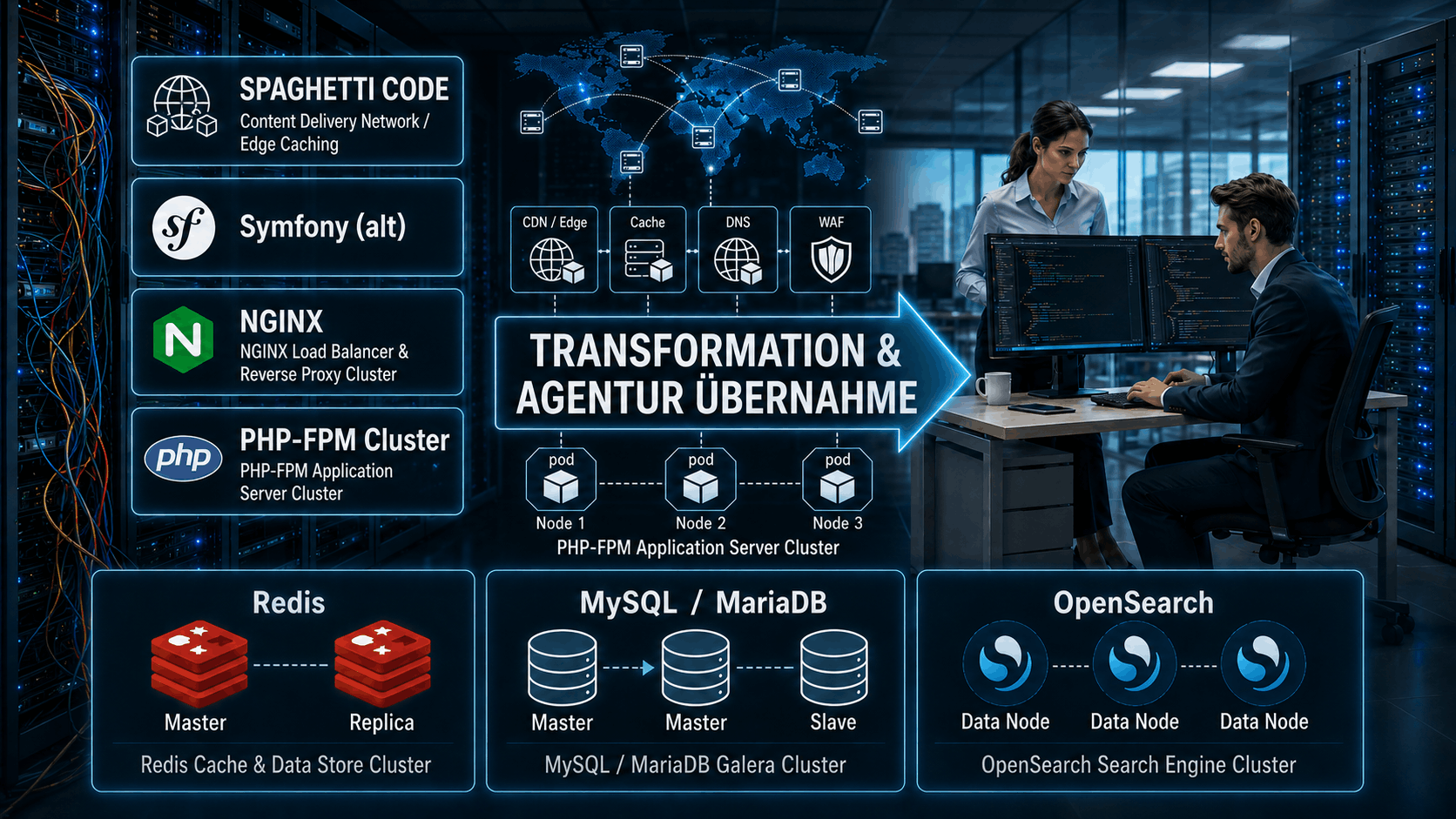
The costs of a Shopware agency vary because they depend directly on the developers’ experience, the agency’s specialization and the depth of services offered. An accurate calculation requires factors such as the complexity of the online shop, the number of installed plugins and the need for ongoing support to be taken into account. Companies should transparently evaluate the expected services and the agency’s qualifications.
Differences Between Small Teams, Freelancers and Specialized Agencies
Small teams and freelancers often offer lower hourly rates because their organizational structures are leaner and they incur fewer overhead costs, such as costs for training and certifying developers with Shopware. These models may be sufficient for simple Shopware shops or clearly defined development tasks.
For more complex Shopware systems with existing data flows, ERP integrations or custom plugin landscapes, however, these structures reach operational and technical limits more quickly. Specialized agencies generally have broader teams covering different disciplines such as architecture, backend development, DevOps and integration, enabling even complex system landscapes to be analyzed and developed reliably.
Impact of System Complexity and Integration Effort
A major factor in the cost structure is the complexity of the existing system landscape. The more external systems such as ERP, CRM or logistics solutions are connected, the greater the technical coordination and development effort.
The number and, in particular, the quality of existing plugins as well as custom modifications to the Shopware core also have a significant impact on project costs. Undocumented extensions or historically grown architectures first require a comprehensive analysis phase before stable further development is even possible.
Why the Hourly Rate Is Not a Realistic Cost Indicator
The pure hourly rate of an experienced agency says very little about the actual total cost of a Shopware project. What matters far more is how efficiently a team can analyze, stabilize and further develop existing systems.
A low hourly rate may appear attractive in the short term, but often leads to higher total costs if technical debt is not recognized, architectural problems only become visible late, or integrations have to be reworked multiple times. The supposed price advantage is also reversed if implementation takes 50% longer due to insufficient expertise and additionally blocks go-live. In the worst case, the Shopware shop struggles with business-threatening outages while the service provider is structurally unavailable.
Experience from Many Years of Emergency Support
In complex Shopware systems, therefore, the decisive factor is not the price per hour, but the ability to identify risks early and solve them in a structured manner. The greatest costs arise not in development, but in correcting systems that were not fully understood.
When Low-Cost Agency Models Become Problematic
A seemingly attractive hourly rate almost always shifts effort and risks into the maintenance and operating phase at a later point. Critical budget overruns primarily threaten when:
- Technical debt and architectural errors remain undiscovered
- Core updates are blocked by non-standard-compliant programming
- Unstable interfaces require manual data corrections in daily operations
Our 30 years of project experience show that subsequently fixing these deficiencies costs many times more than the amount initially saved.
The Role of Support, Maintenance and Availability
The operational reliability and long-term cost control of an e-commerce system depend directly on proactive maintenance and guaranteed response times. Professional system support includes automated monitoring, continuous security patches and validation of update compatibility. The absence of binding emergency processes (24/7 SLAs) leads directly to revenue losses during system outages and puts data integrity at risk.
Factors That Influence Costs in Shopware Projects
When taking over a shop, a significant share of the budget goes toward regulatory and technical safeguarding of the existing system. Typical and necessary efforts before functional further development include:
- In-depth analysis of the existing Shopware architecture
- Code review of all installed plugins and core modifications
- Reconstruction and mapping of data flows to the ERP/CRM system
- Data-protection safeguarding (data-processing agreements, access governance)
Existing Plugins and Custom Extensions
Extensions outside the official Shopware Store are significant risk factors. Every custom development must be checked at source-code level for performance bugs, security vulnerabilities and compatibility with the Shopware 6 core. Missing documentation of these dependencies forces time-consuming reverse engineering in order to rule out system conflicts during future minor or major updates.
ERP, CRM and Third-Party Interfaces
The API infrastructure connecting leading systems determines the technical complexity and ongoing operating costs of an online shop. Synchronous or asynchronous synchronization of inventory, B2B pricing logic and customer data requires error-free validation mechanisms. In addition to integration itself, the effort primarily includes implementing failover logic and interface monitoring in order to automatically intercept data inconsistencies.
Technical Debt from Previous Projects
Legacy issues resulting from poor decisions in the past are primary cost drivers during system takeovers. They manifest themselves in poorly performing database queries, insufficient horizontal scalability or blocked update paths. Systematically reducing this technical debt through targeted refactoring is essential in order to make the system maintainable over the long term.
Missing Documentation and Historically Grown Structures
The absence of current system documentation drastically extends every troubleshooting process in live operation. Without transparent specifications for custom adaptations, the incoming agency must carry out time-consuming source-code analyses before every intervention. This lack of transparency increases operational risk during deployments and drives up initial effort unnoticed.
Technical Problems That Frequently Occur in Existing Shops

Practice shows a clear pattern of recurring system risks: unstable plugin interactions, asynchronous ERP synchronization with data loss, and massive performance losses caused by missing or faulty caching strategies. In addition, non-standard-compliant modifications often block the deployment of critical Shopware 6 core security updates. These factors increase liability risk and drive up ongoing operating costs.
Plugin Conflicts
Incompatible dependencies between extensions lead to unpredictable system behavior or complete failures of the Shopware 6 core in production. Identifying these conflicts requires deep debugging processes at code level, noticeably increasing unplanned maintenance effort and therefore operating costs.
Unstable ERP Synchronization
Faulty API synchronization with ERP systems puts the data integrity of the entire company at risk. Incomplete synchronization loops lead to incorrect inventory levels in the shop, incorrect B2B customer prices or blocked order imports in the ERP. The cause usually lies in insufficient validation and logging structures in the interface.
Performance and Cache Problems
Faulty caching strategies result in high response times (TTFB) and a poor conversion rate. Common causes are unoptimized database indexes or cache bypasses during API requests. Resolving them requires exact configuration of in-memory databases (Redis), HTTP caches (Varnish) and error-free integration of CDN structures in order to ensure scalability under load.
Lack of Updateability Due to Incompatible Plugins
Plugins developed outside the official Shopware interfaces (events/services) block the updateability of the overall system. With every core update, these modules risk breaking, delaying the deployment of security patches. Removing these blocks requires costly code adaptations or complete replacement of the modules.
Lack of updateability due to hard-coded changes. Modifications directly in the Shopware 6 core completely eliminate automated updateability. Every minor update carries the risk of completely overwriting these hard-coded adaptations and putting the system into an unstable state. A manual code review is mandatory before every update, massively multiplying maintenance costs.
How a Shopware Agency Analyzes and Takes Over Existing Shops

A structured onboarding process is the only way to minimize risks during a system takeover and ensure a seamless transition. A professional takeover follows a strict technological protocol:
- Holistic system audit (architecture, database, codebase, APIs)
- Risk assessment of critical system dependencies
- Stabilization of live operations without functional intervention
- Definition of a technological priorities roadmap
- Controlled handover of infrastructure, CI/CD pipelines and maintenance
The top priority is always: controlled stability before premature change.
Technical Analysis of the Existing System
A sound core audit is the prerequisite for all further development work. It includes an in-depth technical review of the system architecture, database indexes and Redis and Varnish configurations. Only in this way can hidden single points of failure be located and the system’s scalability validly assessed.
Evaluation of Plugins and Interfaces
Every extension and every API connection undergoes a functional risk assessment. The goal is to filter out incompatible or poorly performing modules that jeopardize Shopware 6 updateability. The stability and error handling of data-exchange processes (ERP, CRM) are audited in detail.
Taking Over Hosting, Deployment and Maintenance
The final takeover consolidates the infrastructure and operational deployment processes with the new partner. This includes establishing a stable deployment workflow, configuring the hosting environment (e.g. Varnish, Redis, CDN) and implementing robust monitoring systems. The goal is to ensure system stability, secure the updateability of the Shopware 6 core and establish professional support for the long-term operation of the e-commerce system.
Risks That Can Arise When Changing Shopware Agencies

Changing service providers involves calculable risks that are amplified by a lack of transparency on the customer side. Critical factors include incomplete documentation, concentration of system knowledge among individual people at the previous agency, and interfaces implemented without standardized API specifications. The primary risk almost never lies in the change process itself, but in the incompletely documented current state of the legacy system.
The greatest risk is not the change itself, but the lack of transparency about the actual state of the system.
Dependency on Individual Developers
Concentrating exclusive system knowledge in individual people represents a major operational risk. If the logic of custom extensions is not documented, knowledge transfer to the new agency takes considerably longer. Professional structures mitigate this risk through complete documentation and broad distribution of knowledge within the team.
Undocumented Extensions
Undocumented custom code forces the new agency to carry out time-consuming reverse engineering. Without technical specifications, onboarding times and project durations inevitably increase. This creates unforeseen additional costs and raises the risk that hidden error sources jeopardize stability after deployments.
Missing Access Credentials or Infrastructure Information
Incomplete or delayed transfer of permissions immediately blocks the takeover process. Without complete server, database and hosting-provider logins, in-depth system analyses are impossible. Full access to infrastructure parameters (Redis, Varnish, Git repositories) is the basic prerequisite for an on-schedule takeover.
Problems with Running Integrations
A lack of coordination during the handover phase can temporarily disrupt synchronization with third-party systems. Without precise handover protocols, active ERP or CRM interfaces may become unstable. The direct consequences are incorrect inventory levels and delayed logistics processes in day-to-day operations.
Why a Professional Takeover Pays Off in the Long Term
Investment in a structured system takeover pays for itself across the entire lifecycle of the online shop. It secures:
- Stable, automated release and update processes
- Lower ongoing maintenance costs through a standards-compliant architecture
- Elimination of unplanned system outages in live operation
- Validly calculable and predictable functional further development
Investing in a professional agency always saves money in the end.
How Long-Term Maintenance Costs Can Be Reduced

Clean software architecture, standardized API interfaces and continuous technical support are the primary levers for reducing Total Cost of Ownership (TCO). Proactively avoiding technical debt through an experienced agency safeguards system scalability and prevents unforeseeable additional costs during ongoing operations.
Costs Through Continuous Technical Support
A proactive maintenance contract reduces long-term IT costs by eliminating system risks early. Regular minor updates, automated monitoring of log files and continuous cache optimization prevent expensive emergency interventions. This structured approach protects the conversion rate and minimizes the risk of data-protection violations under the GDPR.
Optimizing System Architecture to Reduce Costs
Targeted refactoring of the system architecture sustainably reduces ongoing development effort. By eliminating redundant plugins, cleaning up orphaned database data and consistently using the official Shopware API, the complexity of the overall system is reduced. This accelerates implementation of future features and drastically lowers costs for core updates.
Avoiding Hidden Costs Through Transparent Processes
Targeted refactoring of the system architecture sustainably reduces ongoing development effort. By eliminating redundant plugins, cleaning up orphaned database data and consistently using the official Shopware API, the complexity of the overall system is reduced. This accelerates implementation of future features and drastically lowers costs for core updates.
Predictable Agency Takeover Instead of Unforeseeable Costs
A supposedly low hourly rate almost always leads to expensive additional charges without a structured code audit. Minimize your financial risk through our transparent onboarding.
Cost & Effort Estimate
We analyze your existing plugin landscape in advance and locate hidden technical debt from the previous agency.
Your advantage: You gain a transparent commercial planning basis instead of facing unpredictable cost risks. Request an EstimateLegally Secure Handover Checklist
We ensure the lossless transfer of all server, hosting-provider, Git and API access credentials while taking GDPR compliance into account.
Your advantage: Complete data sovereignty and comprehensive protection against source code or customer data leaks. Download ChecklistBinding Service Packages (SLAs)
No more automated ticket emails without action. We guarantee honest response times with immediate start of troubleshooting.
Your advantage: Maximum revenue protection through guaranteed developer availability in critical situations. Compare Maintenance PackagesAcute Project & Checkout Rescue
We ensure the lossless transfer of all server, hosting-provider, Git and API access credentials while taking GDPR compliance into account.
Your advantage: Fast troubleshooting and restoration of the full operational order flow. Request Express SupportFAQ on Shopware Agency Costs and Hourly Rates
Why Do Shopware Hourly Rates Differ?
The variance in hourly rates reflects agencies’ technological specialization, quality assurance and operational depth of service. A certified partner with proven expertise in complex enterprise architectures and ERP integrations guarantees standards-compliant implementation and long-term system stability. Lower-cost models or freelancers reach capacity limits more quickly with demanding infrastructures, making project risks and timelines unpredictably higher.
Why Are Existing Shops Often More Expensive Than New Projects?
While a greenfield project starts with a clean, controlled architecture, taking over an existing system resembles an investigative inventory. Historically grown plugin structures, undocumented custom code, past mistakes in the codebase and complex third-party system integrations require an intensive preliminary analysis phase. Transparency about the system must first be established before actual further development can begin.
When Is Changing Agencies Worthwhile?
Changing service providers makes economic sense when maintenance costs rise progressively, system stability decreases or support is not reliably available. A lack of billing transparency, sluggish response times to errors or the absence of strategic technological e-commerce consulting are also clear indicators. A professional partner brings the necessary expertise to stabilize stuck systems and align them for the future.
What Risks Arise with Poorly Documented Shops?
Poorly documented systems lead to major schedule delays, unforeseeable additional costs and an increased risk of deployment errors. Without technical specifications for interfaces and adaptations, analysis effort increases with every ticket. This leads to longer downtime in serious incidents, blocks security updates of the Shopware 6 core and severely restricts scalability during seasonal business.
How Does Budgeting Differ Between a Fixed Price and Billing by Effort?
A fixed price does provide commercial planning security, but requires a complete, rigid project specification in advance. Every subsequent change during implementation (change request) must be billed separately and often at higher rates. In addition, a fixed-price offer must always include a calculated contingency buffer for unforeseen issues, artificially increasing initial project costs. For agile system takeovers or continuous optimization in live operation, transparent billing based on actual effort (Time & Material) via a ticket system is the more economical method. It gives you maximum flexibility because development resources can be directed dynamically and flexibly to where they currently generate the highest ROI (Return on Investment).
What Hidden Costs Threaten with an Incomplete Shop Takeover?
The primary cost drivers after an unstructured agency change lie in undiscovered dependencies. If legacy debt — such as outdated PHP versions, incompatible third-party plugins or unclean modifications to the Shopware core — is not identified in advance through a technical audit, massive follow-on costs threaten. These later appear as blocked core updates, unstable API interfaces to ERP systems or unexpected performance drops during important seasonal business. Professional onboarding systematically minimizes this financial risk through a structured inventory before the first productive code intervention.
How Is the Effort Required to Preserve SEO Rankings Calculated When Changing Service Providers?
Changing agencies must never jeopardize your online shop’s organic visibility. The effort required for SEO safeguarding includes detailed validation of existing URL structures, complete mapping of 301 redirects for structural changes, and monitoring data integrity in Google Search Console after system onboarding. These preventive measures create a calculable initial effort, but prevent drastic revenue losses caused by the sudden loss of hard-earned search-engine rankings.
When Does a Monthly Maintenance Contract (Retainer) with Fixed SLAs Pay for Itself?
A monthly allocation of hours with guaranteed Service Level Agreements (SLAs) pays for itself for every online shop whose economic success depends on permanent system availability. Without fixed SLAs, support in the event of an incident follows the so-called best-effort principle — the agency responds only when free capacity happens to be available.
A retainer contractually guarantees response times of up to 4 hours (faster in emergencies). Critical checkout errors or acute server bottlenecks are therefore immediately prioritized and resolved before measurable revenue losses arise. Proactive monitoring and continuous patches also drastically reduce unplanned, expensive emergency effort.
What Does a Contractually Guaranteed Response Time (SLA) Mean in Practice?
In the e-commerce market, the term “response time” is often used misleadingly. Many service providers define a response merely as an automated confirmation from the ticket system or a manual reply such as “We have received your message.” For you as a shop operator, this purely administrative response is worthless in a serious incident if critical errors block checkout or the system is offline. We define response time as the binding start of actual technical troubleshooting by a certified Shopware developer. If you book a maintenance package with an SLA of, for example, 4 hours, for us that means: within this period, a technician is working on your source code, analyzing the problem and working to resolve the error. This honest and transparent interpretation of Service Level Agreements effectively safeguards your live operations instead of leaving you stuck in a queue with bureaucratic phrases.
Mathias Goldhan
Mathias Goldhan laid the foundation for today’s digital agency in 1994 and has been leading HQ GmbH strategically and operationally since 2005. With more than three decades of experience in software development and systems architecture, he advises medium-sized businesses and brands on the digitalization of business-critical processes. He is the strategic mind behind HQ GmbH’s positioning among the Top 100 owner-managed digital agencies (iBusiness/BVDW).
As a recognized SaaS pioneer and specialist in high-performance hosting, he designs highly available cluster infrastructures and leads the technical rescue of stalled large-scale e-commerce projects. He contributes his expertise in resilient systems and API-based B2B automation internationally between the company’s headquarters in Thuringia and its branch in Spain.