Optimize Shopware Hosting Performance: Scalable Shopware Hosting & High Availability for Shopware 6
Ein stabiles Frontend und optimierte Core Web Vitals sind im modernen Online-Handel Pflicht. Doch die beste Code-Optimierung läuft ins Leere, wenn die darunterliegende Infrastruktur bei Traffic-Spitzen einknickt.
In our overarching guide to Shopware 6 performance optimization, you can learn which frontend-side levers you need to apply in parallel. In addition, our specialist article shows how in-depth Core Web Vitals optimization sustainably protects your Google visibility.
For B2B decision-makers, professional Shopware hosting is not an IT cost item, but a business-critical lever. For sysadmins, it is the fundamental tool that determines uncompromising system stability, minimal loading times and maintenance-free nights.
Anyone operating complex e-commerce platforms on standard infrastructure is leaving revenue on the table and risking checkout timeouts. With the far-reaching architectural changes in the current Shopware 6.7 series and the massive performance gains under PHP 8.4 and PHP 8.5, every demanding e-commerce project already needs a dedicated, perfectly tuned Shopware server — a requirement that will increase further with the major Shopware 6.8 release announced for 2027.
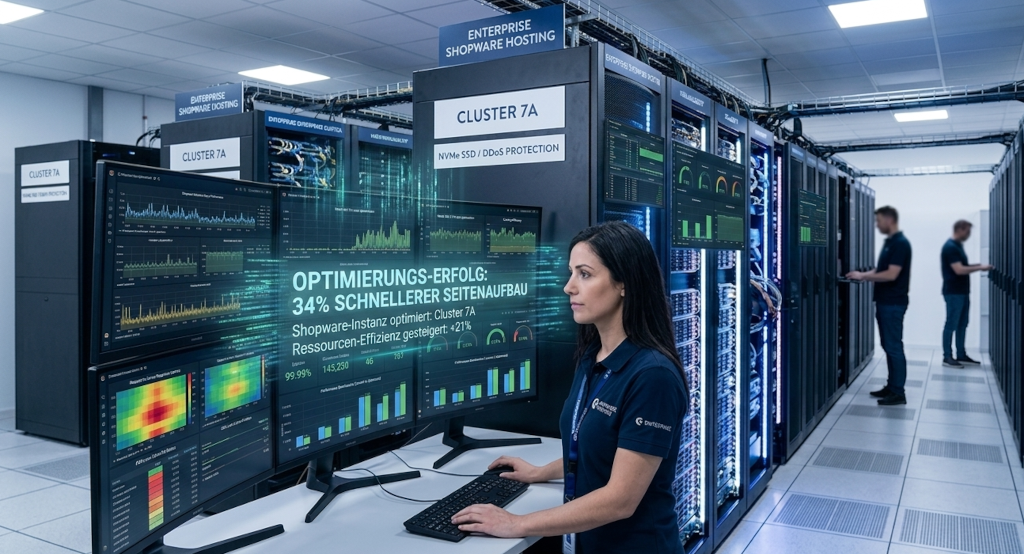
The Business Perspective: Why Standard Hosting Destroys Your ROI
Every millisecond of delay in page rendering costs real money. In the enterprise segment, an inadequate server architecture leads to noticeable economic losses:
- Cart Abandonment: Up to 40% of users leave a page that takes longer than 3 seconds to load (according to Akamai’s core performance studies); for purely mobile traffic, Google even records immediate bounce rates of up to 53%.
- Declining Conversion Rate (CR): A 100-millisecond delay in response time can reduce the conversion rate by up to 7%.
- Loss of Visibility: Google relentlessly penalizes slow server response times (TTFB) in search-engine rankings.
Note for Sysadmins and Technical Decision-Makers: A detailed breakdown of the exact server-side causes and measurement methods can be found in our specialized deep dive on optimizing Shopware TTFB.
Case Study: Black Friday Scaling in B2B Wholesale (Infrastructure Upgrade to v6.7)
- Starting Point: A Shopware 6 omnichannel retailer regularly experienced server timeouts (HTTP 504 Gateway Timeout) during marketing campaigns. CPU utilization jumped to 100% with 500 simultaneous users (Concurrent Users).
- The Measure: Migration to a dedicated, high-performance managed server with a separated database, PHP 8.4/8.5 FPM optimization, a Redis instance for session handling and finely tuned JIT/OPcache.
- The Result in Numbers:
- Reduction in TTFB from 850 ms to 45 ms (18 times faster).
- Stable performance at peak load of more than 5,000 Concurrent Users.
- Increase in conversion rate during the sales event by 24%.
Are you facing a similar load peak? In our free, non-binding e-commerce audit we check your current infrastructure for weaknesses.
Why High-Performance Shopware Hosting Is a Business Issue Today
Many companies still view hosting purely as a technical cost factor. In practice, however, infrastructure directly determines the revenue, scalability and operational stability of a Shopware shop. Especially in enterprise e-commerce, the biggest performance problems arise not in frontend code, but deep within the server and database architecture.
Slow database queries, blocking I/O processes, missing caching strategies or overloaded PHP-FPM workers immediately lead to longer loading times, unstable checkouts and declining conversion rates. Even a few hundred milliseconds of additional response time can cause significant revenue losses for heavily trafficked shops — especially in mobile traffic or during load peaks such as Black Friday, TV campaigns or seasonal sales events.
There is also an economic factor that is often underestimated: technical debt within the infrastructure. Many companies still run Shopware 6 on historically grown hosting environments without a clear scaling strategy. The result is rising operating costs, increasing maintenance effort and ever more complex error patterns during deployments, database migrations or plugin updates. Internal teams therefore spend increasingly more time firefighting instead of carrying out genuine further development.
Modern Shopware hosting must therefore deliver significantly more than traditional web space. High-availability cluster architectures, high-performance NVMe storage systems, intelligent caching layers, Redis-based session-handling systems and automated scaling mechanisms via Kubernetes or comparable platforms are crucial. Only then can high numbers of concurrent users be handled reliably without API requests, shopping carts or checkout processes collapsing.
For CTOs, Heads of E-Commerce and technical decision-makers in particular, infrastructure therefore becomes a strategic business decision. Poorly scaling hosting not only causes technical problems — over the long term, it increases personnel costs, makes international expansion more difficult and limits the growth of the entire digital sales channel.
We explain in detail how modern cluster and high-availability architectures for Shopware are built in the following technical guide to Shopware hosting optimization.
The Sysadmin Perspective: Deep Dive into the Perfect Shopware 6.7 Configuration — with a View to 6.8
Inbound Traffic Nginx / Varnish (SSL Termination & Caching) PHP 8.4/8.5 FPM Node 1 (Worker) PHP 8.4/8.5 FPM Node 2 (Worker) MySQL Primary (Write / Core) MySQL Replica (Read Only) Redis (2 Instances) (Sessions & Cache)Shopware 6 is based on the Symfony framework and places extreme demands on the interplay between web server, PHP-FPM, memory and storage. With the cache rework in Shopware 6.7.12.2 (July 2026), the core architecture has already changed noticeably: via the new sw-cache-hash mechanism, the HTTP cache now remains active even for logged-in customers and filled shopping carts. The old sw-states cookie logic will be completely replaced with the major Shopware 6.8 release announced for 2027; from then on, foreign-key checks are also intended to be processed directly in the DAL instead of through database exception handlers, further relieving the database.
1. Web Server & PHP 8.4 / 8.5 Tuning: Rethinking Scaling
Use Nginx in combination with PHP-FPM. Under PHP 8.4/8.5, Shopware 6.7 already benefits greatly from optimized property hooks and asynchronicity in the core, but requires precise RAM management — advantages that will deepen further with the planned 6.8 release in 2027.
- JIT Compiler (Just-In-Time): Enable the JIT compiler for CPU-intensive tasks such as DAL validation in Shopware 6.
- Optimized OPcache Configuration (
php.ini):
opcache.enable=1
opcache.memory_consumption=768
opcache.interned_strings_buffer=64
opcache.max_accelerated_files=75000
opcache.validate_timestamps=0
opcache.jit_buffer_size=128M
opcache.preload=/path/to/shopware/var/cache/prod_xxx/srcShopware_Core_KernelProdContainerCorePreload.php
Note: From version 6.8 onward (announced for 2027), Shopware will process foreign-key checks directly in the DAL via PHP instead of through database triggers. PHP preloading in combination with JIT already saves valuable CPU cycles per API and store request today — and will become even more relevant with the move to 6.8.
2. Database Tuning (MySQL 8.0.28+ / MariaDB 10.11+)
Shopware 6 generates complex table joins. From Shopware 6.8 onward (announced for 2027), redundant exceptions in the database layer will also be eliminated. Even today, I/O tuning remains business-critical:
Redo Logs & I/O: innodb_log_file_size = 2G prevents bottlenecks during massive asynchronous imports via the Shopware Message Queue.
Additional Tip: Since Shopware 6.7.8.0 (March 2026), the old increment-based message-queue statistics system has been marked as deprecated and will be completely removed with 6.8.0.0 (2027) — it produced inaccurate values anyway due to hard-coded multipliers. You can already disable it today via shopware.admin_worker.enable_queue_stats_worker: false and thereby avoid unnecessary tracking overhead before the more precise statistics solution, already active since 6.7.8.0, takes over.
(Source: developer.shopware.com, Release Notes 6.7.8.0, section “Deprecation of increment-based message queue statistics”.)
InnoDB Buffer Pool: Set innodb_buffer_pool_size to 60% to 75% of the total available RAM in order to keep read access entirely in memory.
3. Redis & Cache Compression: The Zstd Revolution
Use the highly efficient zstd instead of gzip for storing caches. This significantly reduces CPU load when decompressing cache content under PHP 8.4/8.5. It is essential to set up two separate Redis instances:
- Instance 1 (Session Storage): Prevents file locks (file-based session deadlocks) and keeps sessions persistent across server nodes.
- Instance 2 (App & HTTP Cache): With the cache rework in Shopware 6.7.6 — the preliminary stage to complete replacement of sw-states in 6.8 — Redis already caches more dynamic storefront requests highly efficiently today.
Strategic Decision: Shared, Cloud or Managed Shopware Hosting?
| Criterion | Shared Hosting | Public Cloud (AWS/Azure) | Managed Shopware Hosting |
|---|---|---|---|
| Performance | Poor (Bad Neighbor Effect) | Scalable, but extremely complex | Excellent (Dedicated Resources) |
| Maintenance Effort | Low | Extremely high (in-house cloud ops required) | Zero (Fully Managed) |
| Shopware 6.7/6.8 Readiness | Not available (often missing PHP versions, Redis, Elasticsearch and Varnish) | Must be built in-house with considerable effort | Preconfigured out of the box |
| Cost Efficiency | High (but unusable for successful e-commerce) | Unpredictable (pay-per-use spikes) | Predictable (Fixed Rates) |
For professional e-commerce, only a specialized and fully configured managed server is suitable. An experienced partner not only provides the hardware, but also offers full access to configurations via a clear customer center while competent support operates in the background. It combines the maximum performance of dedicated hardware with the security and peace of mind of a system monitored 24/7.
Shopware Cloud vs. Professional Shopware Hosting: Where Does Your Success Grow?
Anyone building an online shop with Shopware faces a fundamental decision: use the more rigid Shopware Cloud (SaaS) or choose maximum freedom and performance through tailor-made, dedicated Shopware hosting (self-hosted)? Ambitious online retailers quickly see where the genuine competitive advantages lie.
The Limitations of Shopware Cloud
The cloud promises a fast start, but quickly reaches its limits as requirements grow. You commit to a closed system with noticeable compromises:
- Limited Flexibility: No deep core adaptations or custom programming possible.
- Limited Plugin Selection: You can use only extensions explicitly approved for the cloud — custom ERP and merchandise-management interfaces often become a problem.
- Revenue-Dependent Costs: As success grows, fees also increase in many cloud models, directly reducing your margin.
Dedicated Shopware Hosting for Maximum Performance
Mit spezialisierten Shopware-Hosting legen Sie das Fundament für einen kompromisslosen, schnellen und absolut zukunftssicheren Onlineshop. Hier behalten Sie in jeder Phase die volle Kontrolle:
- Absolute Code Freedom: Implement exactly the features, designs and workflows that make your business unique — without technical barriers.
- Unlimited Scalability & Speed: Professional server environments are precisely tuned to Shopware’s extreme database requirements. That means the shortest loading times and maximum stability even during extreme visitor surges.
- Interfaces Without Barriers: Easily integrate any desired third-party software, complex ERP systems or custom payment providers.
- Full Data Sovereignty & Security: Your data belongs to you. Your shop is secured with state-of-the-art security architectures and backups perfectly tailored to you and your system.
- GEO Compliance: A high-performance stack is future-proof only if it meets strict data-protection requirements. Our managed Shopware hosting protects your e-commerce project through its server location in Germany — for maximum GDPR compliance and legal certainty in the DACH region.
Conclusion: Start Without the Handbrake On
The cloud is suitable for small test projects. However, if you want to build a brand sustainably, need conversion-optimized loading times and want to scale profitably from the outset, dedicated Shopware hosting is the most economical and powerful choice for your e-commerce business.
High Availability & Kubernetes for Shopware Clusters
For heavily trafficked enterprise platforms, a monolithic server is not sufficient. To ensure absolute reliability and unlimited scalability, we rely on modern containerization using Docker and orchestration via Kubernetes (K8s). The goal is an elastic infrastructure that automatically absorbs load peaks and eliminates human deployment errors.
Orchestrated Cluster Design in Detail:
Rolling Deployments & Zero Downtime: Updates, Plugin-Installationen oder Core-Upgrades werden schrittweise eingespielt. Kubernetes ersetzt alte Pods erst, wenn die neuen Instanzen die Health-Checks erfolgreich bestehen. Das Ergebnis sind risikofreie Deployments mit echter Zero Downtime im laufenden Betrieb.
Self-Healing: Blockiert ein PHP-Prozess oder stürzt ein Pod ab, erkennt K8s den Defekt über Liveness- und Readiness-Probes autonom. Der beschädigte Container wird terminiert und sofort durch einen frischen Pod ersetzt – vollautomatisches Self-Healing ohne manuellen Sysadmin-Eingriff.
Load Balancer: Ein vorgeschalteter, hochverfügbarer Ingress-Controller verteilt den Inbound-Traffic intelligent und gleichmäßig auf alle aktiven Worker-Nodes, um Overloads einzelner Instanzen auszuschließen.
Handling Stateful Services in the Cluster
While PHP workers operate statelessly, stateful services such as databases and caches require special high-availability architectures within the cluster:
- Redis Sentinel: Ensures automated failover for session handling and the app cache. If the Redis master fails, Sentinel promotes a slave to the new master within seconds.
- Galera / Managed DB: A synchronous multi-master cluster (such as MariaDB Galera) ensures that write and read operations run absolutely synchronously across all database nodes and are immediately compensated if one instance fails.
Global Performance & Edge Security via CDN
To relieve the cluster and achieve minimal global loading times, we integrate a Content Delivery Network (CDN) such as Cloudflare directly into the network infrastructure:
Enterprise Security: An upstream Web Application Firewall (WAF) and AI-supported Bot Protection block DDoS attacks, SQL injections and malicious scrapers before they reach the actual cluster infrastructure.
Edge Caching & Next-Gen Compression: Static assets and complete storefront pages are cached directly in the global edge network. Data compression is performed using the highly efficient Brotlimethod.
State-of-the-Art Protocols: Full support for HTTP/3 (QUIC) and TLS 1.3 guarantees the fastest possible connection establishment and military-grade encryption.
Automated Image Optimization: Images are adapted on the fly to the user’s device and delivered in resource-efficient WebP or AVIF format.
Monitoring & Observability for Shopware 6 Infrastructure
In upper-tier e-commerce, blind trust is fatal. A modern Shopware 6 infrastructure requires complete transparency. Only those who can see performance bottlenecks, database anomalies or API errors before they block customers at checkout can act proactively. We rely on a multi-layer observability stack that centrally combines metrics, logs and traces.
Infrastructure & Metrics
We reliably monitor classic system states (CPU, RAM, storage, I/O load) via checkmk. For dynamic Kubernetes clusters, we use a combination of Prometheus for time-series data collection and Grafana for highly visual real-time dashboards.
Central Log Management
Billions of log lines from Nginx, PHP-FPM and the Shopware core are streamed via Loki directly into Grafana or aggregated through a dedicated ELK Stack (Elasticsearch, Logstash, Kibana). This enables root-cause analysis of error messages within seconds.
Application Performance (APM)
For in-depth code analysis, we use OpenTelemetryindependently of vendors. Tools such as New Relic or Sentry capture PHP exceptions and frontend JavaScript errors in real time, even before the customer contacts support.
Deep Profiling for Developers and Sysadmins
When standard metrics provide no explanation for why a specific API call or cart load is stalling, deep profiling is used:
- Blackfire: Enables developers to create exact profiling graphs of PHP execution. It isolates slow SQL queries, inefficient loops within third-party plugins or memory leaks down to the exact line of code.
- Proactive alerts ensure that irregularities in transaction behavior (e.g. a sudden drop in successful checkouts) are escalated immediately via Slack, Teams or PagerDuty.
Security, Hardening & Compliance for Shopware Hosting
An online shop without uncompromising protection is an incalculable business risk in the enterprise segment. Data leaks, ransomware attacks or malicious outages not only destroy customer trust but also directly violate the GDPR. Secure Shopware hosting protects sensitive customer data and payment flows through a multi-layer defense system at network, server and application level.
Disaster Recovery: Untouchable Backup Infrastructures
Traditional backups on the same server volume provide no protection against targeted ransomware attacks. A professional enterprise setup therefore enforces strict separation: encrypted snapshots are replicated as offsite backups to a separate, geographically remote data center. By using immutable backups (unchangeable storage systems based on the WORM principle: Write Once, Read Many), it is ensured that once-written backups can neither be deleted nor subsequently encrypted by attackers or compromised system accounts for a defined period.
Storage Performance: NVMe Infrastructure Against Checkout Bottlenecks
While CPU and memory are often the focus, in enterprise e-commerce the storage subsystem usually limits scalability. A dedicated Shopware server requires the use of storage media with enterprise NVMe infrastructure in a RAID array. Conventional SSDs collapse under massive parallel read and write operations.
Direkter Einfluss auf den Checkout: Wenn Kunden zeitgleich Bestellungen abschicken, führt unzureichendes Storage zu blockierenden Datenbank-Latenzen. NVMe-Speicher verhindern das Anstauen von Schreibprozessen, halten die transaktionale Integrität aufrecht und eliminieren Timeouts im kritischen Moment des Bezahlvorgangs.
Elasticsearch & OpenSearch: Die Indexierung von komplexen Produktkatalogen und Custom Fields erzeugt massive I/O-Lasten. Dedizierter NVMe-Storage beschleunigt das Lesen und Schreiben von Suchindizes, wodurch Filterprozesse in der Storefront ohne Verzögerung ausgeführt werden.
Multi-Region & CDN Edge Routing
For internationally operating e-commerce companies, physical distance from the primary data center is the greatest enemy of performance. To guarantee minimal loading times worldwide, we extend Shopware hosting with a decentralized edge architecture.
Through intelligent Geo Routing the customer's request is automatically forwarded to the geographically nearest Edge POP (Point of Presence). Static assets and storefront HTML are delivered there directly from the network node's volatile memory. An integrated Origin Shield acts as an additional caching layer in front of the actual main cluster (origin server) to protect it against sudden traffic waves (thundering herd problem). If a disruption occurs in the primary data center, automated Failover Routingimmediately redirects traffic to a redundant backup system without interrupting connections.
Perimeter & Network Security
DDoS Protection & Rate Limiting: Eine mehrstufige DDoS Protection fängt massive Layer-3/4-Angriffswellen ab. Granulares Rate Limiting auf Applikationsebene verhindert Brute-Force-Attacken auf den Admin-Login und blockiert aggressive Scraper.
Isolated Networks & VPN Access: Die Server-Nodes kommunizieren ausschließlich über isolierte, private Netzwerke (VLANs). Der Zugriff auf sensible Management-Schnittstellen (wie SSH oder Kubernetes-APIs) ist strikt auf einen gesicherten VPN-only Access beschränkt.
Server Hardening & Access Control
Fail2Ban: Überwacht kontinuierlich die Logdateien des Systems und sperrt IP-Adressen automatisiert auf Firewall-Ebene aus, wenn diese wiederholt auffälliges Verhalten oder fehlerhafte Logins zeigen.
Secret Management: Datenbank-Passwörter, API-Keys und Verschlüsselungs-Tokens werden niemals im Klartext oder im Git-Repository hinterlegt. Sie lagern geschützt in dedizierten Systemen (wie HashiCorp Vault oder Kubernetes Secrets) und werden verschlüsselt zur Laufzeit injiziert.
Why Is Normal Web Hosting Not Sufficient for Shopware 6.8?
Shopware 6 is based on the Symfony framework and Twig (storefront) as well as Vue.js (administration). Even in the current 6.7 series, this modern architecture requires significantly more CPU performance and RAM for process handling than older systems — a requirement that will rise further with the major 6.8 release announced for 2027. Shared-hosting environments limit PHP resources (memory_limit, max_execution_time), which leads to slow loading times in daily operations and abandoned checkouts. A dedicated managed server is therefore indispensable for professional platforms.
What Has Changed in HTTP Caching in Shopware 6.8?
With the cache rework in Shopware 6.7.6 (January 2026), HTTP caching has already changed fundamentally: via the new sw-cache-hash mechanism, the cache now remains active even for logged-in customers and filled shopping carts. Complete replacement of the old cookie-based sw-states logic is planned for the next major 6.8 release (announced for 2027). Combined with strategic Shopware cache optimization, this already minimizes loading times throughout the checkout process and noticeably relieves the system.
Why Is Professional Support So Important for an E-Commerce Project?
During critical performance drops or database locks in a marketing campaign, every minute counts. Competent support that understands Shopware 6’s core architecture can adjust server parameters in real time and resolve system bottlenecks immediately. For maximum reliability, specialized Shopware maintenance contracts and emergency support are used.
How Much RAM Does a Future-Proof Server Need for Shopware 6.8?
With logic being moved into the PHP layer (PHP 8.4+ JIT and DAL foreign keys), memory_limit per PHP process should be set to at least 512 MB to 1 GB. The ratio of memory to storage must be perfectly balanced: for a productive enterprise system, 64 GB RAM and ultra-fast NVMe storage are the recommended standard.
What Does a Secure Backup Strategy for Enterprise Shopware Hosting Look Like?
Automated backups must be created at short intervals (e.g. hourly for databases). Physically separated data backup is essential for disaster recovery. This means that encrypted, immutable backups are stored on independent storage clusters outside the primary server.
Should Elasticsearch / OpenSearch Be Installed Directly on the Web Server?
No. Elasticsearch/OpenSearch requires significant resources for search indexing. Since Shopware 6.7.8.0, more custom fields are also indexed automatically — specifically those used in product sorting, product streams or apps; additional fields can be added via plugin when required. To prevent mutual resource blocking, the search engine must be decoupled onto a dedicated instance. More in-depth consulting on this setup can be found in the Analysis and Consulting section.
(Source: developer.shopware.com, Release Notes 6.7.8.0, section “Indexing the product’s custom fields”; additionally: Shopware Docs, “Add more Fields to Product Search”.)
What Functions Does a Modern Customer Center Offer with a Managed Server?
A professional customer center enables sysadmins to quickly manage SSL certificates, configure PHP versions (e.g. switching to PHP 8.4/8.5), view real-time monitoring data and control cron jobs granularly without necessarily having to use SSH.
What Does High Availability (HA) Mean for a Shopware Cluster?
A high-availability system uses redundant components (such as mirrored databases and multiple PHP worker nodes behind a load balancer) to ensure that the platform remains online and ready for transactions even if a physical server fails. Such a fail-safe design is implemented most efficiently through modern enterprise hosting cluster systems.
Why Is File-Based Session Handling Fatal in Cluster Hosting?
When session data is stored as files on the server, enterprise systems under load experience critical session deadlocks that block PHP workers. Multiple server nodes in the cluster also cannot access local files. Using a central, fast Redis instance for session handling is therefore essential.
How Does the Technical Expertise of an Enterprise Hoster Differ from Mass-Market Hosting Providers?
In-depth technical expertise is demonstrated by proactive kernel and stack optimization. A specialized hoster configures asynchronous queues, JIT compiler assignments and zstd compression precisely for the Symfony structure instead of merely providing predefined standard web packages. You receive comprehensive support from us as a certified Shopware agency.
How Does Kubernetes Infrastructure Handle Unpredictable Load Peaks in Shopware 6.8?
Unlike traditional server hardware, which rigidly reaches its CPU and RAM limits during traffic waves, Kubernetes infrastructure completely decouples the application from physical limits. Using the Horizontal Pod Autoscaler (HPA), the system continuously monitors CPU utilization and memory profiling of the PHP workers. As soon as a defined threshold is exceeded — for example due to a massive surge on an uncached checkout during a marketing campaign — Kubernetes automatically replicates new stateless Shopware pods within seconds. An intelligent ingress load balancer distributes incoming traffic evenly across the new instances. When the load drops after the campaign, the cluster autonomously scales down again in order to effectively minimize unused infrastructure costs (autoscaling ROI).
Why Are High Random IOPS and an Optimized Queue Depth Crucial for Storage?
In upper-tier e-commerce, sequential read speed is not the decisive factor, but performance during random read and write access (Random Read/Write IOPS). Even today, Shopware 6 generates an enormous number of simultaneous tiny database write commands through asynchronous import processes via the message queue and parallel checkout transactions — a load that is expected to increase further with the 6.8 release planned for 2027. Conventional SATA SSDs encounter an I/O bottleneck here because their queue depth is severely limited. Enterprise NVMe drives in a RAID array process even extreme queues synchronously in the microsecond range. This prevents write processes from accumulating at block level. It drastically reduces database latency at the business-critical moment of payment and protects the system against timeouts (HTTP 504 Gateway Errors) directly in the shopping cart. The result is permanently stable, measurably optimized Shopware TTFB.
Mathias Goldhan
Mathias Goldhan laid the foundation for today’s digital agency in 1994 and has been leading HQ GmbH strategically and operationally since 2005. With more than three decades of experience in software development and systems architecture, he advises medium-sized businesses and brands on the digitalization of business-critical processes. He is the strategic mind behind HQ GmbH’s positioning among the Top 100 owner-managed digital agencies (iBusiness/BVDW).
As a recognized SaaS pioneer and specialist in high-performance hosting, he designs highly available cluster infrastructures and leads the technical rescue of stalled large-scale e-commerce projects. He contributes his expertise in resilient systems and API-based B2B automation internationally between the company’s headquarters in Thuringia and its branch in Spain.