commercetools to Shopware Migration: Strategic E-Commerce Optimization
Migrating an existing enterprise platform is not just an IT project, but a strategic business decision. For companies looking for a specialized Shopware agency for their replatforming, this step determines the operational efficiency, total cost of ownership (TCO), and agility of the entire enterprise.
Similar to a Magento to Shopware migration, a system change via a Shopify to Shopware migration, scaling through a Woocommerce to Shopware migration, or the replacement of legacy systems via an Oxid to Shopware migration, replacing a pure composable architecture like commercetools presents strategic questions that go far beyond mere data mapping. This guide provides enterprise decision-makers and system architects with the technological basis for decision-making – and shows why such a technology change and a change of Shopware agency usually inevitably go hand in hand.
Why the change? Strategic reasons for migrating from commercetools to Shopware
When companies actually switch from commercetools to Shopware
- high operating costs for multiple microservices
- lack of internal development resources
- Marketing is dependent on IT.
- Too long time-to-market.
- Meta-architecture for medium-sized enterprise setups
- Desire for consolidation
Technological Freedom vs. Total Cost of Ownership (TCO)
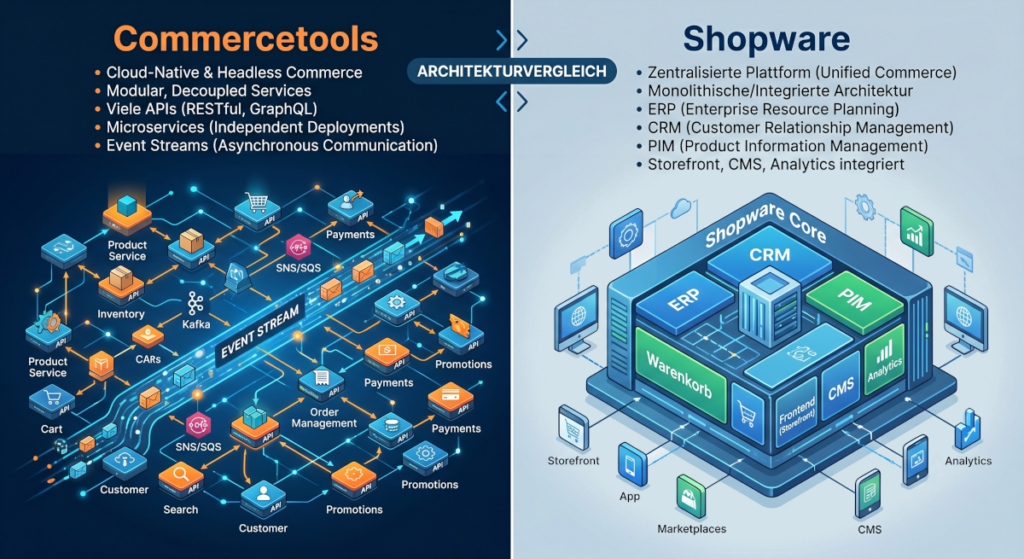
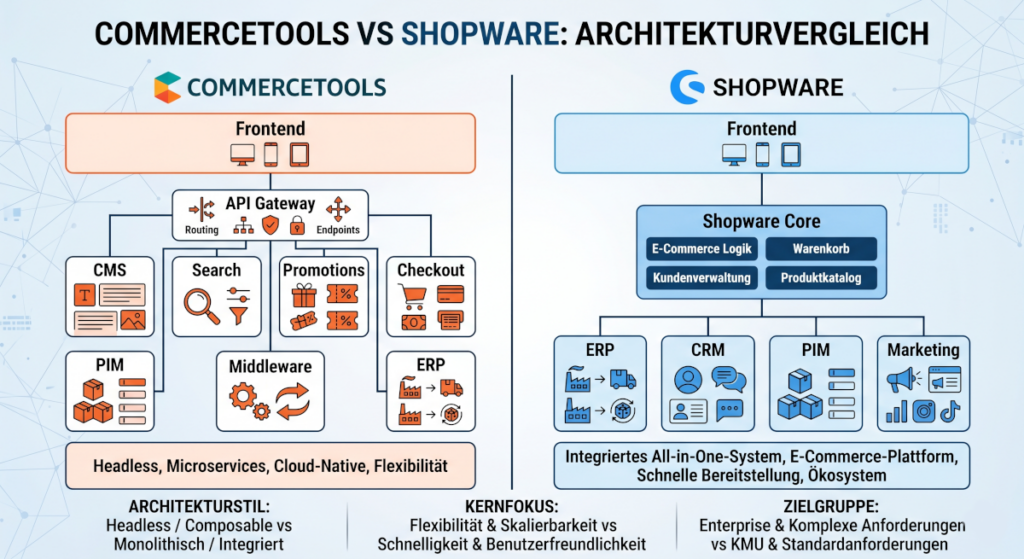
Operating a pure composable commerce architecture based on commercetools ensures maximum technological freedom, but often comes at the cost of a massive increase in TCO and operational complexity. While commercetools requires dedicated microservices or third-party solutions for every standard function – from the promotion engine to the checkout – Shopware Enterprise offers native feature parity in the core.
For many B2B and B2C companies, this consolidation is the decisive lever for recapturing excessive license and maintenance costs for dozens of individual services without losing flexibility.
Reducing API interfaces and operational complexity
Every interface is a potential point of failure. Migrating to Shopware drastically reduces the number of APIs that need to be maintained. Shopware combines the advantages of a stable core (integrated business logic, central data model) with the benefits of modern API-first systems (hybrid-composed approach). In plain terms: the management of fragmented integration points is simplified, the risk of errors in data exchange is reduced, and the system architecture becomes maintainable again.
Time-to-market and increased efficiency with Shopware
With commercetools, even a simple discount promotion often requires the coordination of multiple microservices and developer resources. Shopware Enterprise breaks open this bottleneck. Campaigns and experience worlds are set up directly in the standard backend, without having to adapt complex orchestration layers. This relieves the IT department and gives marketing back the agility that is critical to success in modern e-commerce.
System Architecture Comparison: MACH Principle vs. Shopware Enterprise Platform
Architectural Foundations of commercetools
The core of commercetools is strictly based on the MACH principle (Microservices, API-first, Cloud-native, Headless). Each entity is isolated, and communication occurs asynchronously via events. This offers developers a greenfield for best-of-breed strategies but requires a highly specialized in-house team to permanently ensure data consistency across all services.
Hybrid Composed Approach of Shopware Enterprise
Shopware Enterprise counters the rigid "best-of-breed" constraint with a highly flexible core and app system. Core processes are mapped stably and performantly in the system, while subsystems can be flexibly adapted via API. This approach offers the robustness of an integrated system with the extensibility of an API-first platform.
Choosing an operating model: Cloud vs. Self-Hosted
When replatforming, companies are moving towards three different operating models:
Shopware SaaS: Completely eliminates infrastructure management. Ideal for companies looking for near-standard processes with maximum maintenance relief.
- Shopware PaaS: The provider manages the infrastructure below the application level — Shopware itself describes Shopware Cloud PaaS as a managed cloud infrastructure with reduced operational overhead.
Shopware Self-Hosted / On-Premise: With upstream caching layers (Varnish, Redis), companies can achieve a high level of scalability and performance with full control over individual business logic and data sovereignty — with significantly lower operational complexity than with a distributed microservices architecture like commercetools.
The migration roadmap: Replatforming without data loss
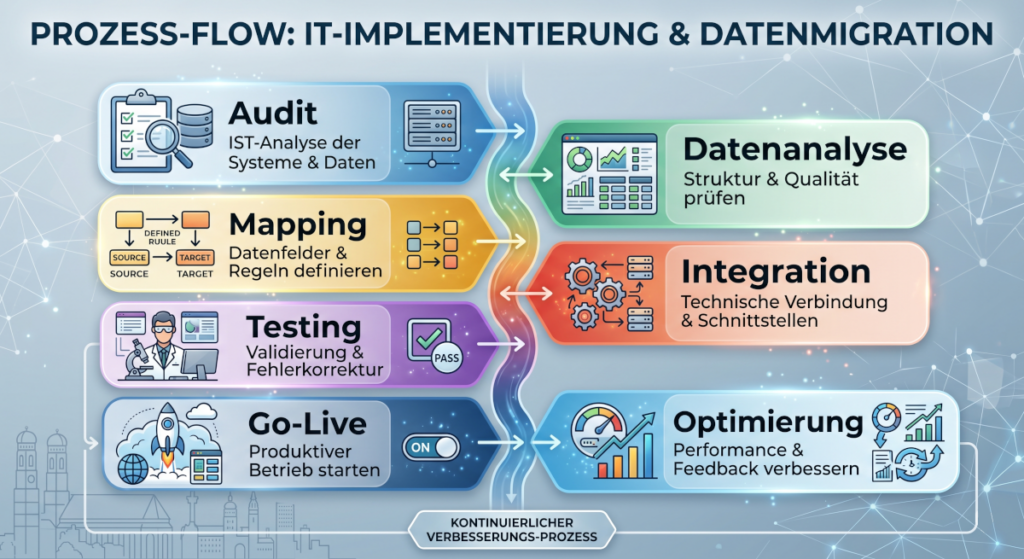
Successful replatforming does not follow a "big bang" approach, but rather a strictly sequential, data-centric migration path.
Data Migration: Complex Attribute Mapping
The transfer from commercetools to Shopware is done via a direct API-to-API migration or structured ETL tools. The biggest hurdle lies in the data model: commercetools uses highly fluid product types with freely definable, but typed attributes — there is no fixed global schema as with Shopware. Shopware, on the other hand, requires a clear separation between fixed variant properties (for storefront filtering) and dynamic custom fields.
The mapping must translate this structure precisely so that multi-dimensional variants (e.g., size/color in B2C or tiered pricing in B2B) end up in Shopware's relational schema without data loss. Historical order data and customer profiles are validated incrementally and transactionally securely via the Shopware Sync API.
API and Integration Mapping: Consolidating Middleware
With commercetools, the system landscape is usually orchestrated via event architectures such as AWS EventBridge or Azure Service Bus. When shifting to Shopware, these structures need to be consolidated. Shopware comes with an integrated Message Queue System (based on Symfony, scalable via RabbitMQ), providing a native solution for asynchronous processes. Integration points to leading systems such as ERP (SAP, Microsoft Dynamics) or PIM (Akeneo, Pimcore) are remapped so that Shopware acts as a central, consolidated endpoint for the core processes. This minimizes payload traffic throughout the entire system.
Frontend Change: Optimizing Core Web Vitals and UX
If a completely proprietary headless frontend was operated under commercetools, Shopware allows two paths. The most efficient way to reduce technical ballast is to switch to the native Shopware frontend or to use Shopware Composable Frontends (based on Next.js/Nuxt.js).
The goal is to optimize the TTFB (Time to First Byte). While pure headless architectures often suffer from client-side rendering delays, Shopware enables minimal loading times and a significant improvement in Core Web Vitals out-of-the-box through highly efficient server-side rendering (SSR) in combination with edge caching.
Costs of a commercetools to Shopware migration
The cost of migrating from commercetools to Shopware depends significantly on the existing system landscape, the number of integrations, and the individual degree of platform customization. Unlike a classic shop relaunch, enterprise replatforming is not just about transferring product and customer data, but about the strategic realignment of the entire commerce architecture.
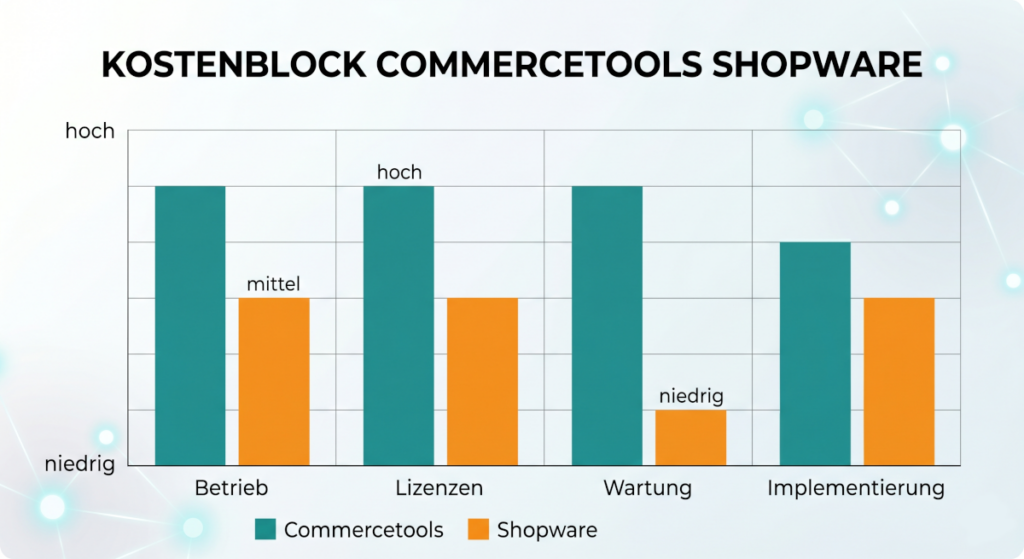
The main cost drivers include the complexity of the data model, the number of connected systems (ERP, PIM, CRM, Marketing Automation), individual business processes, and the decision between Shopware Cloud and a self-hosted architecture. Companies with highly individualized workflows typically invest more in the migration phase but benefit from significantly lower operating and maintenance costs in the long term.
Typical project sizes in comparison
| Project scope | Products | Integrations | Project duration |
|---|---|---|---|
| Mid-Market | up to 25,000 | ERP + Payment Provider | 3–6 months |
| Enterprise | 25,000–100,000 | ERP, CRM, PIM, BI | 6–12 months |
| Enterprise Plus | 100,000+ | complex multi-system landscape | 9–18 months |
Which cost traps will be eliminated after the migration?
Many companies choose Shopware not primarily because of new features, but because of the ability to consolidate their existing commerce landscape. While commercetools often requires the operation of numerous additional services, middleware solutions, and third-party products, many of these functions are already provided natively in Shopware.
This allows the following cost blocks, among others, to be reduced:
- Middleware and integration costs
- Third-party licenses for promotions, CMS, or checkout processes
- Maintenance efforts for complex microservice landscapes
- Infrastructure and hosting costs
- Development effort for standard commerce functions
- Monitoring and operating expenses
ROI and amortization of the migration
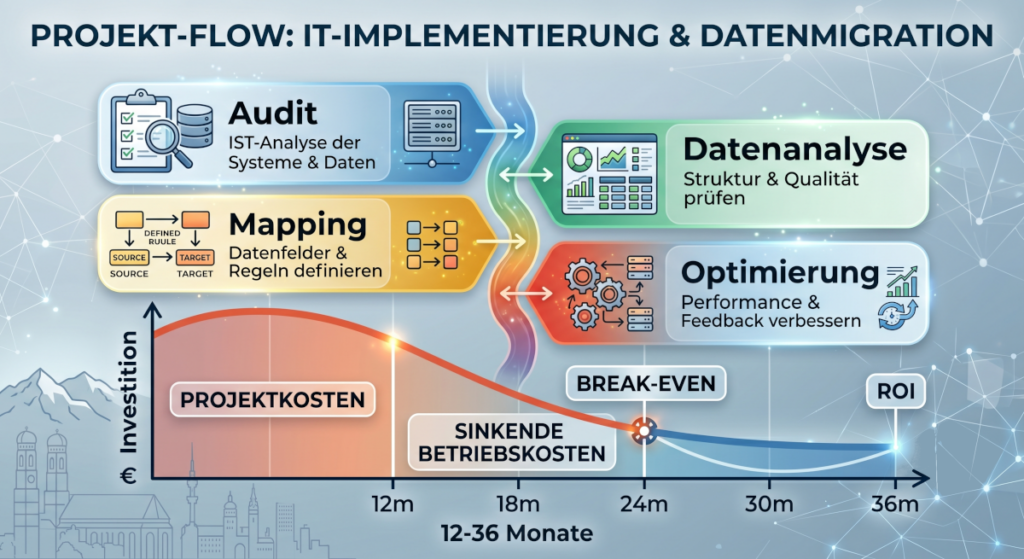
The economic evaluation of a platform migration should not be reduced to project costs alone. The long-term view of the Total Cost of Ownership (TCO) is crucial. In many enterprise projects, the greatest savings are not achieved through cheaper licensing models, but through the reduction of technical complexity, lower maintenance costs, and faster implementation times for new business requirements.
After a successful consolidation, companies often benefit from significantly shorter development cycles, lower operating costs, and a noticeable relief for their internal IT teams. Depending on the architecture, degree of integration, and organizational structure, the investment in replatforming often pays for itself within 12 to 36 months.
Strategic assessment:
The more robust an existing commercetools architecture is, consisting of numerous microservices, middleware components, and individual integrations, the greater the potential savings from consolidating it onto a centralized Shopware platform.
Expert assessment
For many companies, migrating from commercetools to Shopware is less a technological decision than a business one. While commercetools offers maximum flexibility, operating, development, and integration costs increase with each additional service. Shopware pursues a consolidated approach that provides many standard functions in the core, thereby significantly reducing the long-term total cost of ownership. This is precisely why many replatforming projects focus on economic optimization rather than technical feasibility.
SEO & GEO-Protection: Maintaining Rankings and Semantic Authority
Switching platforms carries immense risks for organic visibility. Since the routing logic of the URLs changes fundamentally, a seamless 301 redirect strategy is mandatory. Every old API-driven URL structure must be deterministically mapped to the new Shopware SEO URLs to prevent 404 errors and the loss of historical rankings.
Structured data for LLM crawlers (GEO)
For Generative Engine Optimization (GEO) – i.e., findability in AI-powered search engines like Perplexity or Google AI Overviews – maintaining semantic authority is crucial. LLM crawlers require highly structured data to understand entities. The Schema.org markup (Product, Offer, AggregateRating) is cleanly implemented in the Shopware templates. In contrast to some JavaScript-heavy headless constructs, Shopware ensures that this content is perfectly parsed and indexable directly in the HTML source code for both LLM crawlers and the Googlebot.
Technical Pitfalls – and How to Avoid Them
API rate limits: commercetools strictly limits requests by tenant. A massive data dump during migration quickly leads to timeouts. The solution: use the Shopware Sync API to process payloads bundled in bulk operations.
Asynchronous vs. synchronous workflows: While commercetools works purely asynchronously, Shopware expects synchronous responses for critical core processes (such as inventory checks in the checkout). These paths must be isolated early in the migration design.
Authorization structures: The granular custom permissions model of commercetools does not correspond 1:1 with the user roles in Shopware. An early mapping of the role and rights matrix to the Shopware admin roles prevents security gaps after go-live.
Conclusion: The Strategic Decision Matrix for C-Level Decision-Makers
The switch from commercetools to Shopware is not a technological step backward, but a business and operational optimization. The following matrix shows the core differences in a direct comparison:
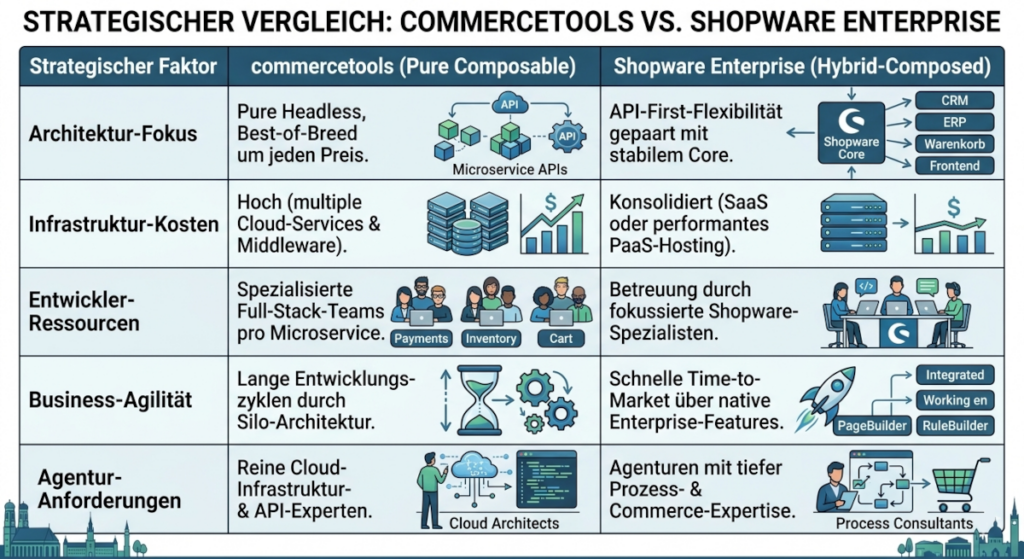
| Strategic factor | commercetools (Pure Composable) | Shopware Enterprise (Hybrid-Composed) |
| Architecture Focus | Pure Headless, best-of-breed at any price. | API-first flexibility paired with a stable core. |
| Infrastructure costs | High (multiple cloud services & middleware). | Consolidated (SaaS or high-performance PaaS hosting). |
| Developer Resources | Specialized full-stack teams per microservice. | Support from dedicated Shopware specialists. |
| Business Agility | Long development cycles due to silo architecture. | Fast time-to-market through native enterprise features. |
| Agency Requirements | Pure cloud infrastructure & API experts. | Agencies with deep process & commerce expertise. |
Why replatforming almost always leads to a change of agency:
A pure composable system like commercetools primarily requires agencies to link APIs and cloud infrastructures. Shopware Enterprise, on the other hand, demands a deep understanding of integrated commerce processes, ERP workflows, and high-performance PHP/Symfony infrastructures. Many companies find during replatforming that their current composable agency cannot map the procedural depth of Shopware – the switch to a specialized Shopware Enterprise agency thus becomes a critical success factor for the entire migration project.
Peak performance for enterprise e-commerce.
Choose your desired solution. Our Certified Solution Architects guarantee smooth processes and measurable revenue increases.
Strategic System Audit
We analyze code quality, databases, and architecture before the project starts.
Avoid costly wrong decisions. Request a technical auditMigration & Relaunch
Rebuild on the most modern code level (Shopware 6) including secure data transformation.
Zero-downtime strategy for the go-live. Start relaunch planning.ERP & CRM Interfaces
Seamless API integration (SAP, MS Dynamics, weclapp) for bidirectional workflows.
Full automation without manual errors. Discuss interfaces24/7 Emergency Support & SLAs
Proactive cluster monitoring and lightning-fast bug fixes during live operation.
Absolute operational reliability around the clock. Request SLA contractFAQ: Frequently Asked Questions about Replatforming & Changing Agencies
Why does migrating from commercetools to Shopware almost always require a change of agency?
The technological ecosystems differ fundamentally. While a commercetools agency specializes in pure cloud infrastructures, event-driven architectures, and the linking of countless APIs (MACH principle), Shopware Enterprise requires a deep understanding of integrated commerce processes, ERP workflows, core caching (Varnish/Redis), and the Symfony framework.
When replatforming, companies often find that the old composable agency cannot map the procedural depth of a hybrid-composed system. Many companies use replatforming as an opportunity to review their existing agency structure and align it with the requirements of the new platform.
How high are the TCO savings when switching from commercetools to Shopware Enterprise?
In many projects, license, middleware, and operating costs can be significantly reduced. However, the actual effect depends on the architecture, degree of integration, and number of third-party systems used. In practice, after consolidation, we see a reduction in operational costs (TCO) of 30% to 50%. commercetools requires its own microservices or third-party licenses for each standard function (e.g., checkout, promotions, CMS), which must be paid for and maintained separately. Shopware Enterprise bundles these features natively in the core, which drastically reduces license fees, maintenance efforts, and middleware costs.
Can an existing commercetools headless frontend be reused with Shopware?
Yes, this is technologically possible via Shopware’s API-first architecture. However, it rarely makes economic sense. Proprietary frontends (e.g., based purely on React or Vue.js) often carry enormous technological baggage and API overhead, which worsens the Core Web Vitals. An experienced Shopware agency will almost always recommend Shopware Composable Frontends (based on Next.js/Nuxt.js) or the native Twig frontend to guarantee minimal TTFB loading times.
What project duration should be expected for an enterprise replatforming?
A structured replatforming from commercetools to Shopware Enterprise takes an average of 6 to 12 months. The most time-critical phases are not the front-end design, but the complex attribute mapping of the fluid commercetools data model to the relational schema of Shopware, as well as the new connection of the leading enterprise systems (ERP, PIM, CRM).
What are the most common technical pitfalls that jeopardize the migration from commercetools to Shopware?
The three biggest risks lie in the system architecture and the data model:
- API rate limits for data extraction: commercetools strictly limits requests by tenant. Anyone who tries to pull millions of data lines via standard APIs will run into timeouts. An experienced agency uses the Shopware Sync API to import data transactionally via bulk operations.
- The conflict between asynchronous and synchronous: commercetools works purely event-driven (asynchronous). However, Shopware requires synchronous responses for critical core processes – such as live inventory checks in the checkout. If these paths are not isolated early in the middleware, the checkout will collapse after going live.
- Fragmented rights mapping: The granular custom permissions model of commercetools cannot be transferred 1:1 to the admin roles of Shopware. Without proper mapping, there is a risk of massive security gaps in the backend.
Christopher Einenkel
Christopher Einenkel is the strategic mind at HQ GmbH for advanced system integrations and complex API architectures. Whenever data synchronizations reach their limits or demanding enterprise systems such as Salesforce need to be connected to Shopify, he designs tailored, high-performance interface logic.
His track record includes the in-house development of proprietary enterprise solutions, including automated AI translation tools for product master data, seamless B2B procurement systems, as well as automated market evaluation and competitive monitoring solutions. In addition, he manages the technical implementation and API integration of digital software call center systems into existing CRM and ERP environments for our enterprise clients.