Shopware 6 Migration: Process, Costs and How to Avoid Downtime
For most companies, now is the right time to switch to Shopware 6. Shopware 5 has no longer received security updates since July 2024, while requirements for performance, security and ERP integrations continue to rise. With a structured migration, downtime and SEO losses can generally be avoided completely through clean redirects.
Below, we show you which criteria help determine the right time, exactly how our technical migration process works and what it has cost in comparable projects.
HQ GmbH specializes in technically demanding Shopware 6 migrations for mid-sized companies and enterprise projects. We combine software development, IT infrastructure, data migration and ERP integration into one end-to-end migration process. Every migration is planned and technically managed by certified Shopware Solution Architects — from analysis and test migration through to a fail-safe go-live.
Why This Issue Is Urgent Now — Even If Your Shop Is Still Running
Shopware officially ended development of Shopware 5 in July 2024. Many shops have continued to run seemingly without issues since then — but this is misleading. Two external factors make 2026 a turning point:
- No More Security Updates. Newly discovered vulnerabilities remain permanently open — a growing risk to customer data and GDPR compliance.
- PHP Shutdowns by Hosting Providers. Shopware 5 runs on outdated PHP versions. Hosting providers are increasingly discontinuing these environments — a forced server update can disable your shop from one day to the next.
- Third-Party Interface Breakage. Payment gateways, ERP connectors and shipping providers are gradually ending backward compatibility with Shopware 5. If a critical interface fails, checkout stops.
Anyone still operating productively on Shopware 5 today is effectively running their shop without manufacturer protection. This is not an acute “the shop will immediately go offline” scenario — but it is a risk that grows every month and becomes significantly more expensive in a serious incident than a planned migration.
The 6 Most Important Signals: When the Switch Is Specifically Worthwhile
| Signal | Why It Supports Migration |
|---|---|
| Shop Still Runs on Shopware 5 | No manufacturer support since July 2024 — security risk is continuously increasing |
| Loading Times & Core Web Vitals Under Pressure | Shopware 6 is technically designed for modern performance requirements |
| Growing B2B Requirements | Tiered pricing, customer groups, custom catalogs and approval processes are natively available in Shopware 6 |
| Multichannel or Marketplace Plans | Shopware 6’s API-first approach simplifies integrations with ERP, PIM and marketplaces |
| Frequent, Expensive Custom Development | Modern architecture noticeably reduces the effort required for customer-specific adaptations |
| Unclear Internal Responsibility for the Shop | Migration is a good opportunity to reorganize processes, hosting and responsibilities |
As a rule of thumb: the more of these points apply, the more urgent the need — and the sooner the investment pays for itself through lower maintenance costs, better conversion rates and reduced outage risk.
What a Migration Realistically Costs and How Long It Takes
Flat-rate prices are not credible for custom shop systems — the range depends on product count, degree of customization, interfaces (ERP, PIM, payment providers) and data history. Realistic reference points for German mid-sized companies:
| Project Type | Time Frame | Typical Complexity |
|---|---|---|
| Standard Migration, Manageable Catalog | approx. 0.5–2 months | Few custom plugins, standard interfaces |
| Migration with B2B Functions & Customization | approx. 2–4 months | Customer groups, price lists, ERP integration |
| Enterprise Migration with Multi-Shop Setup | approx. 4–12 months | Multiple countries/channels, SAP and PIM integration, message queues |
The largest cost factor is rarely the Shopware license or the setup itself, but data migration and adaptation of custom plugins from the legacy system. A clean initial audit identifies exactly these hidden efforts in advance — before a fixed price is calculated.
Our Technical Migration Process: 5 Phases to Go-Live
We work according to a strict, phase-based project model. Each phase concludes with a defined, measurable technical result.
Phase 1: Database Audit & Code Analysis
Detailed analysis of your existing database structures, code quality and plugin dependencies in the legacy system.
- The Result: Cleaned SQL database without orphaned table structures; exact identification and consolidation of all required custom data fields; a risk-free technical migration roadmap.
Your Result After Phase 1
✅ Complete inventory of your system landscape
✅ Cleaned, consistent data foundation
✅ Binding, risk-free migration roadmap
Phase 2: API & ERP Infrastructure Design
Specification and setup of interfaces for connecting your ERP and third-party systems (e.g. via SAP BTP).
- The Result: A detailed, precise API mapping protocol for all data flows; already established and isolated middleware connections in the test environment; elimination of any risk of data synchronization conflicts during the later go-live.
Phase 3: Test Migration (Dry Run) & Quality Assurance
Execution of a complete test migration of all data into a closed staging environment.
- The Result: An operational, realistically tested clone of your new Shopware 6 system; automated validation reports on the integrity of all foreign keys; early identification and correction of potential replication conflicts.
Your Result After Phase 3
✅ Complete test migration
✅ Validated data integrity
✅ No risk at go-live
Phase 4: Frontend Refactoring & Core Web Vitals
Adaptation of the UI design to the Shopware 6 architecture while simultaneously optimizing browser rendering performance.
- The Result: Uncompromisingly lean DOM tree to minimize the INP value (Interaction to Next Paint < 200 ms); optimized critical-path CSS for LCP loading times under 1.5 seconds; maximized mobile conversion rate through extremely fast visual feedback.
Phase 5: Go-Live, Delta Reconciliation & Hypercare
Real-time synchronization of order data accumulated since the test phase and final switch to the production system.
- The Result: Silent, second-precise switch without data interruptions or order pauses; immediate activation of SEO redirects for seamless ranking protection; close live monitoring (hypercare) of all interfaces and transactions directly after launch.
Your Result After Phase 5
✅ No order interruption
✅ SEO redirects active
✅ Monitoring running
Real-World References
cafiro.de — Rebranding & Record Migration (formerly Schornsteinmarkt)

- more than 75,000 main products with up to 750 million variants per product
- Migration from xt:Commerce to Shopware including complete rebranding without loss of SEO visibility
- custom-developed migration tool because standard interfaces could not handle the data load
- mobile PageSpeed score above 90 despite the extreme variant load
- as part of the long-term partnership: subsequent migration from Shopware 5 to Shopware 6
- Full Case Study
Cerberus Kaminhaus GmbH — Multi-Shop Platform wamiso.com
- 13 European country domains
- Central core system for all countries
- Complex geo-routing scenarios in international operations
ski-shop.ch — Relaunch and Migration During Ongoing Operations
- All customer accounts including encrypted passwords migrated
- Complete historical order data transferred
- Smooth go-live without interrupting day-to-day business
Customer feedback after successful Shopware system remediation and long-term support: piercing-store.com
“I originally learned about HQ GmbH through business partners who recommended the company to me. That recommendation has been fully confirmed. Our Shopware shop previously had numerous technical problems that two other agencies had neither identified nor resolved. HQ analyzed the system completely, eliminated all errors and even found additional weaknesses that had previously gone unnoticed. Today our shop runs stably, reliably and significantly better than before.
I especially appreciate the personal, straightforward contact and the exceptionally fast response times. There is a well-founded solution for every problem, and implementation is targeted and carried out with a high level of professional expertise.”
Would you like to know what a fail-safe switch would look like specifically for your shop?
We review your current architecture and show you which migration process is realistic for your catalog, interfaces and revenue profile.
Technical Depth for Your IT Department
In practice, these topics determine project success — and they are exactly what your IT management wants to know before approval.
Migration of Customer & Authentication Data
For Shopware 5 migrations, we distinguish between legacy hash methods (MD5/SHA1 with salt), bcrypt and custom authentication stacks. If direct, lossless transfer of the password hash into the target system is not possible, we implement a lazy-rehash strategy: the customer authenticates in the new system using the old hash, which is migrated dynamically and invisibly in the background to the secure Shopware 6 method (bcrypt/Argon2) only at the moment of successful login.
What This Means for You: Your customers do not have to reset their password during migration — no friction, no support requests, no lost login on the first day after go-live.
Referential Integrity & Database Cleanup
Before every migration, we identify all referential-integrity violations. We clean up orphaned records (e.g. orders without assigned customers), inconsistent foreign-key relationships and duplicate primary-key ranges. The actual data transfer takes place only after this cleanup and consolidation of the tables.
What This Means for You: No dead records or orphaned orders in the new system — every order history remains fully traceable for your team and your customers.
Catalog Scaling, Search Infrastructure & Caching
We consistently separate transactional database workloads from read and search queries (CQRS approach). Product search, filter aggregations and faceted navigation run through Elasticsearch or OpenSearch, while edge caching, reverse proxies and a distributed Redis cache keep loading times low even under heavy load.
What This Means for You: Your product search remains noticeably fast whether your catalog contains 500 or 500,000 products — even on the highest-revenue promotional weekend of the year.
API Infrastructure, ERP Integration & Transaction Security
Depending on your consistency requirements, we implement REST, GraphQL or event-based integrations (e.g. via SAP BTP) synchronously or asynchronously. We buffer high load peaks through message queues (RabbitMQ) so your ERP systems do not become blocked and deadlocks are avoided.
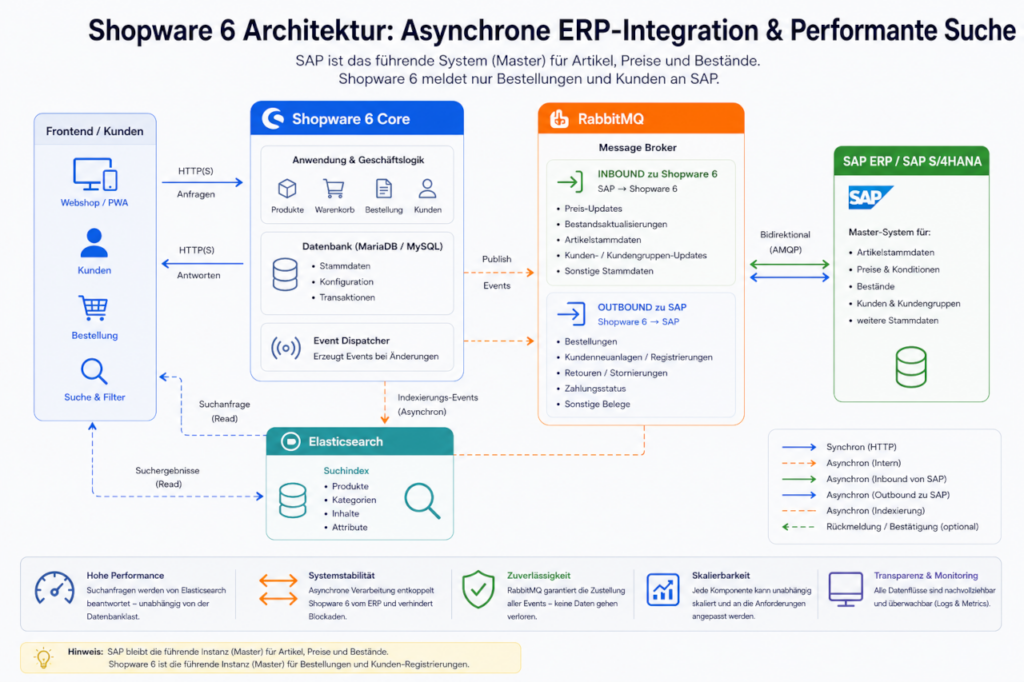
What This Means for You: Your ERP system does not pause for a single second during migration — orders, inventory and invoices continue without interruption.
Automated Deployment Pipeline: How Zero Downtime Is Technically Secured
The reliability from Phase 3 (dry run) and Phase 5 (go-live) is not a promise, but the result of an automated, multi-stage pipeline: every change passes through build, automated tests, a migration simulation on a database copy, a non-destructive online schema migration without table locks, and only then a blue-green deployment with health checks.
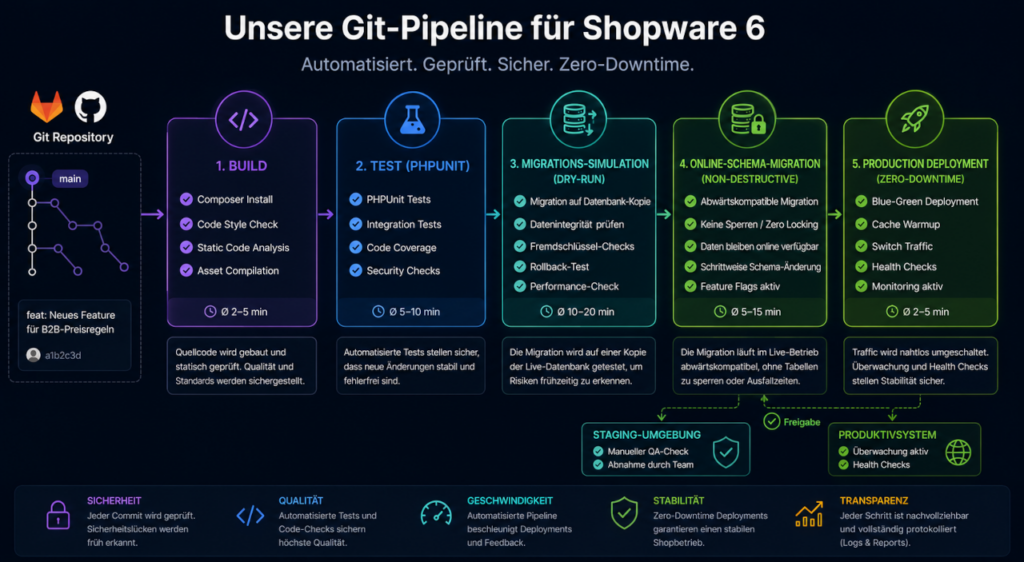
What This Means for You: Schema changes run in the background while your shop remains live and accessible — the actual traffic switch takes only a few minutes and can be rolled back immediately if anomalies occur.
Future Outlook: Agentic Commerce and WebMCP
During migration, we design the architecture so your shop is also prepared for emerging standards such as WebMCP (Web Model Context Protocol) — a W3C standard intended to enable AI agents used by your B2B customers to interact directly and securely with your online shop in the future. This is not a mandatory migration criterion today, but an advantage of a cleanly built API-first architecture that can later be used without rework.
Common Objections — and How We Handle Them
“The migration is too expensive for us and the outcome is uncertain.” That is why we do not begin with a fixed-price quote, but with a free inventory assessment. Only once scope and effort are clear do we discuss costs — transparently and without surprises during the project.
“We do not have our own IT team to manage this.” That is exactly why you receive a dedicated contact person on our side who coordinates project planning, data migration and technical implementation — without requiring you to build additional expertise internally.
“A migration inevitably means lost revenue.” The parallel operation in Phase 3 (test migration) exists precisely for this reason: the old shop remains fully functional until the controlled cutover in Phase 5.
“We currently do not have the budget for a large-scale project.” Nor does anyone need to. Migrations can be divided into phases — core shop first, B2B extensions and additional integrations in a second step once the budget allows.
Frequently Asked Questions About Shopware 6 Migration
Do I Have to Switch from Shopware 5 to Shopware 6 Immediately?
From a technical perspective, your shop will continue to run, but without security updates you bear the full risk of data leaks and server outages from day one — newly discovered vulnerabilities remain permanently unpatched. A switch is therefore not technically forced, but strongly advisable from a business perspective. We recommend beginning planning now instead of waiting for an acute security incident.
Our Shopware 5 System Has Been Running Without Problems Since Mid-2024 Without Support — Why Is Migration Suddenly Urgent After More Than Two Years?
The apparently smooth operation two years after official end-of-life conceals growing technical debt. Two external factors make the timing urgent: hosting providers are increasingly discontinuing the outdated PHP versions on which Shopware 5 runs — a forced server update can immediately disable the shop system. At the same time, third-party providers of payment gateways, ERP connectors and shipping logistics are gradually ending backward compatibility with Shopware 5. As soon as one of these interfaces fails, checkout or ERP synchronization stops.
How Secure Is Commercial Third-Party LTS (Long Term Support) for Shopware 5 Really?
Commercial LTS support does not provide reliable risk coverage because the general terms and conditions of almost all providers restrict remediation obligations through a restrictive reasonableness clause. In practice, this means that if a security vulnerability is deeply embedded in old core components, the obligation to fix it ceases once the effort exceeds the contractual reasonableness threshold. In addition, LTS terms generally contain no obligation to proactively report vulnerabilities that cannot be fixed — in a serious incident, there is no assurance that you will even be warned. If a vulnerability remains open, you alone bear the full liability risk for data loss or GDPR fines; the LTS provider contractually excludes its liability for this. LTS buys time — it does not solve the underlying problem.
How Long Does a Typical Shopware 6 Migration Take?
Depending on complexity, between 0.5 and 12 months. The decisive factors are product count, custom plugins, interfaces to ERP/PIM systems and the scope of required B2B functions.
Can I Continue Operating My Shop During the Migration?
Yes. The new shop is built and tested in parallel in its own environment (Phase 3). The existing shop remains online unchanged until the planned cutover in Phase 5.
What Happens to My Existing Data (Customers, Orders, Products)?
It is transferred in a structured manner, including delta reconciliation shortly before go-live so that no data created in the meantime is lost.
Approximately How Much Does a Shopware 6 Migration Cost?
That depends heavily on the degree of customization. Reliable statements are possible only after an inventory assessment — exactly what the free initial audit provides.
Your Result After a Migration with HQ GmbH
✅ No avoidable downtime at go-live
✅ Preservation of existing SEO rankings
✅ Clean ERP and API integration
✅ Future-proof Shopware 6 architecture
The First Step: Free E-Commerce Audit
Before any decision about migration makes sense, it must be clear where your current shop actually stands — both technically and economically. That is exactly what our free, non-binding e-commerce audit provides:
- ✓ Analysis of performance, architecture and typical bottlenecks in your existing shop
- ✓ Concrete assessment, of whether and when a Shopware 6 migration is worthwhile for you
- ✓ Clear recommendations for action — entirely without sales pressure
Find out where you are currently leaving revenue on the table — free and non-binding.
Alternatively: Prefer to speak directly? 📞 +49 36626 31760 · ✉️ info@hqgmbh.de — for an initial assessment of whether migration, performance optimization or another approach is right for your shop.
Mathias Goldhan
Mathias Goldhan laid the foundation for today’s digital agency in 1994 and has been leading HQ GmbH strategically and operationally since 2005. With more than three decades of experience in software development and systems architecture, he advises medium-sized businesses and brands on the digitalization of business-critical processes. He is the strategic mind behind HQ GmbH’s positioning among the Top 100 owner-managed digital agencies (iBusiness/BVDW).
As a recognized SaaS pioneer and specialist in high-performance hosting, he designs highly available cluster infrastructures and leads the technical rescue of stalled large-scale e-commerce projects. He contributes his expertise in resilient systems and API-based B2B automation internationally between the company’s headquarters in Thuringia and its branch in Spain.