Shopware 6 Performance Optimization: Architecture Instead of Standard Infrastructure
Note on Shopware 6 performance: Where exactly loading time is “lost” — whether in the frontend, in API requests or deep in the database — is individual to each project. This guide serves as architectural orientation. For a dedicated bottleneck analysis of your system, we are happy to support you as a certified Shopware agency .

Acute performance problems in Shopware 6?
Have the bottlenecks in your core architecture and server infrastructure analyzed by our certified experts.
Introduction to Performance Optimization
For mid-sized companies, the performance of an online shop determines conversion rates and customer satisfaction. Efficient optimization, however, begins where standard documentation ends: eliminating structural code latency and precisely tuning the entire infrastructure stack.
How to specifically shorten the server’s first critical response layer is explained in our deep dive on optimizing Shopware TTFB.
Important Performance Factors
The Software & Plugin Layer
A widespread misconception is that performance problems can simply be solved by adding more server resources. If the software architecture works inefficiently in the background, a cache only masks the problem temporarily — until the next cache miss under full load.
The Role of Hosting in Performance
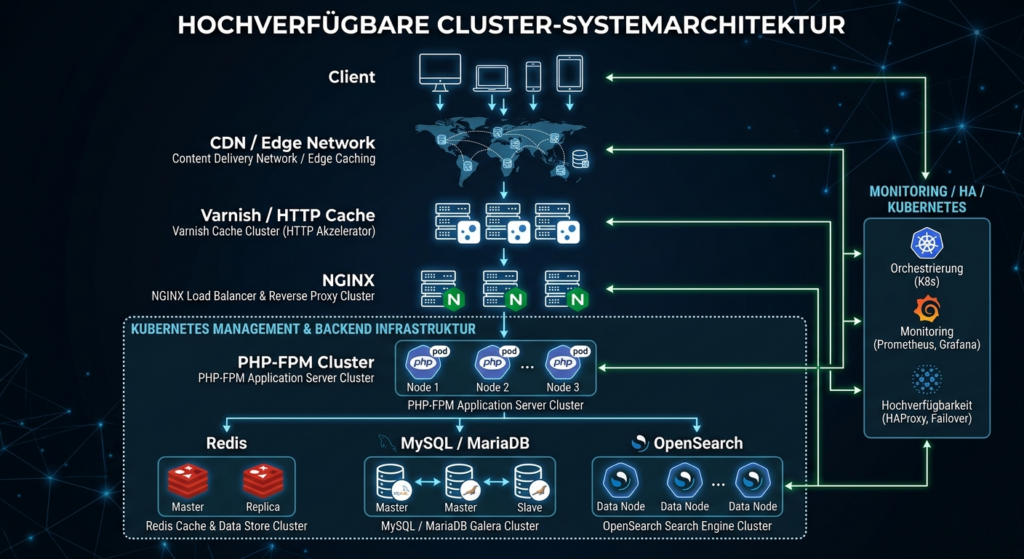
Professional hosting plays a central role in your shop’s performance. A suboptimally configured server can cause massive bottlenecks even with perfectly written software. As a specialized Shopware agency with more than 30 years of experience at the interface between software architecture and infrastructure, we analyze the overall system in order to identify the real bottlenecks.
As a specialist, our technical division offers high-performance hosting environments tailored precisely to Shopware 6 workloads. We take responsibility for optimal server configuration and ensure that your shop receives the necessary resources for fast loading times and uncompromising stability. You can read what such technical remediation looks like in practice in our case study on rescuing a B2C online shop through targeted hosting and code optimization. Detailed adjustment points can also be found in our accompanying guide to Shopware hosting optimization.
Architectural Best Practices for High-Performance Stacks
Frontend code optimization and fine-tuning Core Web Vitals come to nothing if the underlying server architecture stagnates during sudden load peaks. A future-proof setup strictly separates the various services in order to consistently exclude mutual resource blocking.
A deeper look into the Symfony profiler shows why standard configurations fail under real-world conditions:
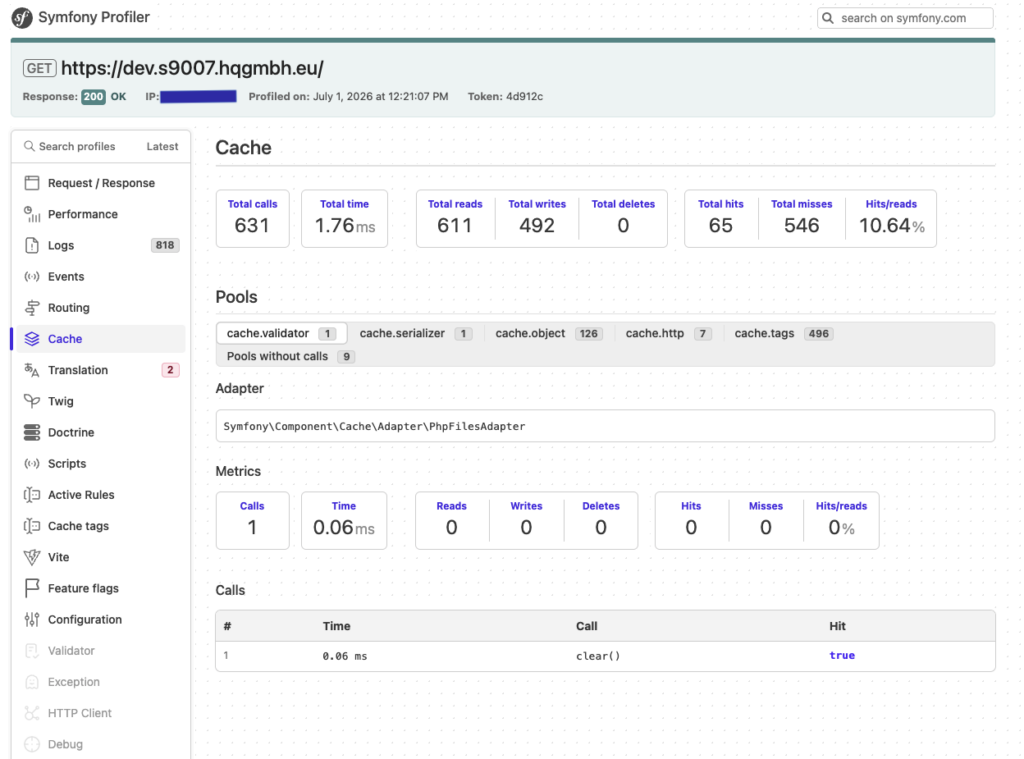
Live-Analyse eines suboptimalen Cache-Setups: This profiler excerpt exposes the typical bottlenecks without embellishment. With a cache hit ratio (hits/reads) of only 10.64% the caching effect is almost completely lost — with 546 cache misses, the server has to regenerate the data with heavy computational effort. Because the file-based standard adapter (PhpFilesAdapter) is also active, the 492 write operations generate massive I/O load on the file system. Under heavy load, this inevitably leads to blocking processes (file locks). Our best practices eliminate exactly these unnoticed performance drains.
1. MySQL & Database Optimization (Eliminating N+1 Queries)
Shopware 6 uses the Data Abstraction Layer (DAL) in its core. Poorly written plugins or unclean theme customizations quickly lead to so-called N+1 query problems: instead of retrieving all required data with a single efficient JOIN, the system fires a separate database query for every individual product in a list. With 48 products on a category page, that means 48 additional, time-consuming round trips.
While we identify acute query bottlenecks in the development environment directly via the integrated Shopware and Symfony profiler, we use specialized profiling tools such as Tideways for continuous monitoring and root-cause analysis under real production load in live operation. This allows us to eliminate inefficient loops directly in the code without burdening the live server with debug overhead.
2. Configuring the PHP Stack & OPcache
Outdated PHP versions are an avoidable security and performance risk. We consistently use current PHP versions (such as PHP 8.4 or 8.5) and optimize the parameters in php.ini. By precisely tuning PHP OPcache (including JIT compilation), precompiled bytecode remains directly in memory, which drastically reduces the execution time of Symfony routines.
3. Dual In-Memory Caching via Redis
File-based session and cache handling inevitably leads to I/O bottlenecks and file locks under heavy load. Our optimized infrastructures use two physically separate Redis instances for this: one exclusively for session handling — centrally stored in Redis, which allows the application nodes themselves to remain stateless and scale horizontally as needed — and the second as an ultra-fast key-value store for the app and Shopware cache.
Continuous Performance Optimization
The Role of Cron Jobs: CLI Worker Instead of Admin Worker
By default, the “Admin Worker” is active in Shopware 6. It executes important system cron jobs (such as cache cleanups or indexing) in the background while real visitors browse the shop. Under high traffic, this blocks HTTP processes and causes server latency to rise uncontrollably.
The Performance Solution (Separating Frontend and Backend): We completely disable the Admin Worker in the backend and move all background-process execution to a dedicated server-side CLI worker via
systemdorsupervisor. Through this strict architectural separation, compute-intensive background tasks run isolated at system level. This prevents admin processes or asynchronous tasks from blocking the storefront’s PHP-FPM workers — customers in checkout retain full server priority at all times.
Monitoring Core Web Vitals
Continuous monitoring of Core Web Vitals — especially Largest Contentful Paint (LCP) and Interaction to Next Paint (INP) — is a decisive component of sustainable stability. Through targeted use of tools such as Google PageSpeed Insights, we obtain precise field data in order to catch gradual slowdowns caused by growing product catalogs or ERP interfaces before they negatively affect your rankings and conversion rates.
Technical Infrastructure for Shopware 6
Frontend code optimization comes to nothing if the underlying server architecture stagnates during sudden load peaks. For e-commerce managers, hosting infrastructure is not a passive IT cost item. It is a direct lever for transactional stability in checkout. Anyone running complex omnichannel platforms or compute-intensive B2B catalogs on inadequately sized standard environments risks timeouts (HTTP 504 Gateway Errors) and revenue losses at the moment of ordering.
Scaling and Future-Proof Safeguarding
While medium-sized systems achieve excellent loading times on a dedicated, high-performance managed server, global platforms require modern containerization with Docker and orchestration via Kubernetes (K8s). With a Horizontal Pod Autoscaler (HPA), the system autonomously responds to traffic waves and adds new Shopware pods at minute intervals, while upstream load balancers distribute traffic evenly.
Optimizing Loading Times
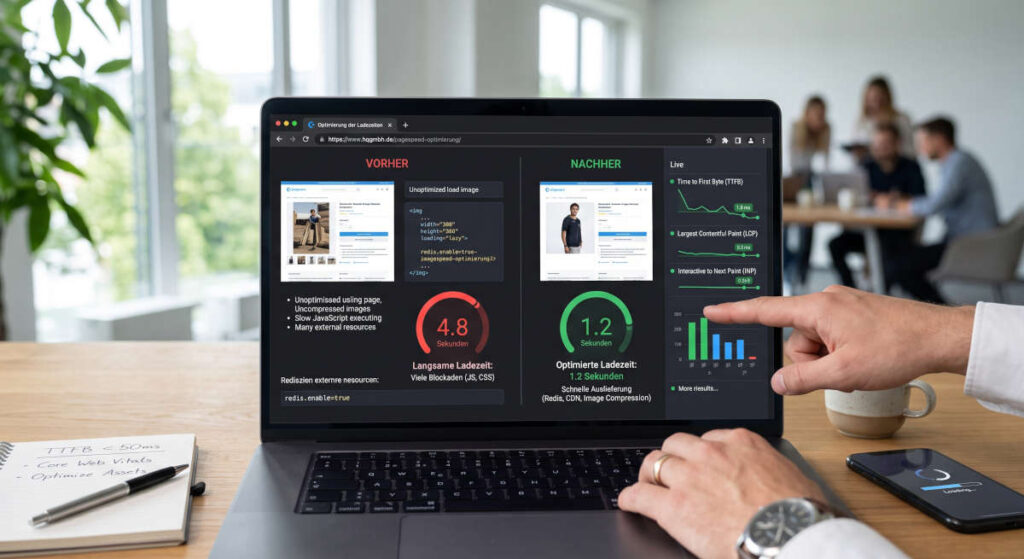
Strategies for Improving Loading Times
Effective optimization of your Shopware 6 shop’s loading times requires an in-depth analysis of resource usage. Error-free Shopware cache optimization measurably relieves the database and prevents unnecessary computing processes on recurring page views.
We begin with a sound system analysis in order to identify the causes of slow loading times. Our expertise as a Shopware agency enables us to create concrete solution proposals that we implement together with your developers and hosting providers. This may involve directly optimizing the existing infrastructure or, if necessary, migrating to our own systems optimized for Shopware 6. The goal is to noticeably increase performance, shorten response times and thereby sustainably improve customer satisfaction and conversion rate, particularly through optimized caching. This ensures that your Shopware 6 shop delivers optimal performance at all times.
Using Caching Strategies
Caching strategies are essential for drastically reducing your Shopware 6 shop’s loading times in standard operation. By using intelligent mechanisms such as Redis for the backend or Varnish as a reverse proxy for the frontend, the number of database queries and server load on anonymous page views are significantly reduced. Static content and standard catalog pages are then delivered to customers from in-memory storage in milliseconds.
The Sword of Damocles in E-Commerce: A high-performance Varnish cache must never be misused as a patch for deep technical debt. As soon as a visitor adds a product to the cart, logs in to a customer account or customer-specific prices are retrieved, full-page caching no longer applies. From that moment onward, every interaction passes unfiltered all the way to the core architecture and database. If the code is poorly structured or blocked by inefficient plugins, performance collapses exactly where it must be most stable: in the business-critical checkout process.
Tools for Analyzing Loading Times
For precise analysis of your Shopware 6 shop’s loading times, we rely on a combination of proven tools and methods. These include detailed examination of loading times and effective cache usage as well as analysis of server logs, database queries and server metrics. We also use Google PageSpeed Insights to identify weaknesses directly against Google’s official UX metrics. As part of our technical analysis and consulting, we carry out detailed Core Web Vitals optimization in order to sustainably secure your search-engine rankings and mobile conversion rate. This comprehensive approach enables us to find the real bottlenecks and take targeted optimization measures.
You can find detailed instructions for measuring and fixing errors in our guide to PageSpeed optimization for Core Web Vitals.
Shopware Performance Optimization Techniques
Using the Shopware Cache Optimally
Efficient use of the cache is a cornerstone of Shopware performance optimization in order to significantly improve loading times. By correctly configuring caching strategies, especially with tools such as Redis for the backend and Varnish for the frontend, static content can be delivered quickly and dynamic content managed efficiently. This significantly reduces server load and accelerates your Shopware shop’s response times, leading to noticeably better performance and higher customer satisfaction. Detailed adjustment of this configuration is crucial for optimal performance.
MySQL Optimization for Better Performance
Optimizing the MySQL database is essential for increasing your Shopware 6 shop’s performance. A slow database can cause significant loading-time delays even when other components are configured well. Our expertise includes analyzing database queries and specifically adjusting the MySQL configuration in order to minimize query times and maximize efficiency. These measures improve overall system performance, resulting in faster loading times and a smoother user experience. A correctly optimized database is the key to stable and fast performance.
PageSpeed Optimization in Shopware 6
PageSpeed optimization in Shopware 6 is crucial for an excellent user experience and better SEO rankings. Through targeted measures such as reducing JavaScript and CSS files, compressing images in WebP or AVIF format, and minimizing Time to First Byte (TTFB), loading times can be drastically shortened. Google PageSpeed Insights is a valuable tool here for identifying weaknesses and receiving concrete optimization recommendations. Comprehensive PageSpeed optimization contributes significantly to increasing conversion rate and overall customer satisfaction.
Continuous Performance Optimization
The Role of Cron Jobs in Optimization
Cron jobs play an important role in continuously optimizing your Shopware 6 shop’s performance by automating recurring tasks. These include, for example, clearing the cache, updating search indexes or cleaning up log files. Correct configuration and regular monitoring of these cron jobs ensure that your shop runs efficiently and resources are used optimally. The Admin Worker in particular is a central component that controls important processes in the background. Precisely adjusting execution intervals and priorities helps avoid load peaks and stabilize overall performance.
Monitoring Core Web Vitals
Monitoring Core Web Vitals is a decisive component of sustainable performance optimization for your Shopware 6 shop. These Google metrics — including Largest Contentful Paint (LCP), Interaction to Next Paint (INP) and Cumulative Layout Shift (CLS) — provide precise insight into the real user experience in terms of loading speed, interactivity and visual stability. By using tools such as Google PageSpeed Insights, we obtain detailed field data and can take targeted measures to continuously improve performance. Proactive monitoring helps identify potential bottlenecks early and permanently safeguard top positions in the search-engine index.
Noticeable Results Through Continuous Optimization
Continuous performance optimization of your Shopware 6 shop leads to noticeable and measurable results. Faster loading times and improved customer satisfaction result in a significant increase in conversion rates and therefore revenue. Customers benefit from smooth and fast checkout times, increasing their willingness to buy. In addition, more efficient resource usage and optimal configuration can lead to server cost savings. These long-term benefits underline the need to understand performance as an ongoing process in order to secure sustainable success in e-commerce.
Technical Infrastructure for Shopware 6
Technical Infrastructure for Shopware 6: The Foundation of Scalable Shopware Systems
Frontend code optimization and fine-tuning Core Web Vitals come to nothing if the underlying server architecture stagnates during sudden load peaks. For e-commerce managers with a clear B2B/enterprise intent, hosting infrastructure is not a passive IT cost item. It is a direct, measurable lever for conversion rate and transactional stability in checkout. Anyone running complex omnichannel platforms or compute-intensive B2B catalogs on inadequately sized standard environments risks timeouts (HTTP 504 Gateway Errors) and significant revenue losses at the business-critical moment of ordering.
Architectural Best Practices for High-Performance Stacks:
- Decoupled Application and Database Layers: The PHP-FPM worker nodes run isolated from the MySQL or MariaDB instances. This prevents compute-intensive DAL operations (Data Abstraction Layer) from blocking the database’s I/O capacities.
- Separation of Elasticsearch / OpenSearch: Indexing complex product catalogs, custom fields and customer-specific prices requires massive RAM and CPU resources. A fail-safe cluster therefore operates the search engine on dedicated server instances.
- Dual In-Memory Caching via Redis: File-based session handling inevitably leads to file locks and blocked processes under heavy load. Enterprise infrastructures use two physically separate Redis instances: one exclusively for stateless session handling across all nodes, the second as a high-performance app and HTTP cache.
- Enterprise Storage with NVMe RAID Infrastructure: During parallel ERP interface synchronization and simultaneous cart checkouts, sequential read speed is not decisive, but the number of random write and read operations per second (Random IOPS). Only dedicated NVMe drives guarantee low database latency at high queue depth.
Scaling and Future-Proof Safeguarding
While medium-sized systems achieve excellent loading times on a dedicated, high-performance managed server, global platforms require modern containerization with Docker and orchestration via Kubernetes (K8s). With a Horizontal Pod Autoscaler (HPA), the system autonomously responds to traffic waves and adds new Shopware pods at minute intervals, while upstream load balancers distribute traffic evenly.
📋 Technical Minimum Requirements (Shopware 6.8)
At least memory_limit = 512M (recommended 1G with intensive use of PHP 8.4+ JIT compilation and complex product streams).
Minimum 32 GB to 64 GB RAM for a single-server setup. In a multi-node cluster, at least 16 GB RAM per stateless PHP app node.
At least 8 dedicated (v)CPU cores with a high single-core clock rate for fast synchronous processing of Symfony requests.
The variable innodb_buffer_pool_size must be set to 60% to 75% of available RAM in order to keep the entire SQL database in fast memory.
Exclusive use of enterprise NVMe drives in a RAID array with at least 3,000 random write IOPS at a queue depth of ≥ 32.
Separation into at least two independent Redis instances (instance 1 for persistent session storage; instance 2 for app and HTTP caches via zstdcompression).
Disable the standard Admin Worker in the Shopware backend. Set up server-side CLI workers via systemd or supervisor to relieve HTTP processes.
Supplemented by proactive monitoring (Prometheus, Grafana, checkmk), physically separate data backups outside the primary data center (offsite & immutable backups), and strict SSH and CIS hardening, this creates a high-availability environment. It protects your platform against outages and permanently safeguards the ROI of your e-commerce project.
Further technical configuration data, specific my.cnf blueprints for PHP 8.4/8.5 and detailed case studies can be found in our technical deep dive on Shopware hosting optimization.
Frequently Asked Questions About Shopware Performance Optimization
Optimize Shopware Performance — from HTTP Cache to High-Availability Hosting
Implementing these complex strategies is a core part of our daily work. As a certified Shopware agency, we ensure that all technical and infrastructure components mesh perfectly in order to extract maximum speed and scalability from your e-commerce platform.
Ready for a digital advantage? Choose your appropriate entry point below for a professional system audit by our enterprise experts:
What Has the Greatest Impact on the Performance of a Shopware 6 Shop?
The biggest performance factors usually lie not in frontend code but in the technical infrastructure. Particularly decisive are hosting architecture, HTTP cache, database performance, Redis handling, PHP-FPM configuration and the quality of the plugins used.
Especially in heavily frequented shops, bottlenecks often arise from slow database queries, insufficient caching or hosting environments that do not scale.
More on technical infrastructure:
Optimize Shopware Hosting Performance
More on loading times and rendering:
Optimize Core Web Vitals
Why Is Standard Hosting Often Not Enough for Shopware?
Shopware 6 is based on Symfony and generates complex database and cache processes. Shared hosting quickly reaches physical limits here.
Insufficient resources, slow storage systems and missing technologies such as Redis, Varnish or OpenSearch lead to long loading times and unstable checkouts.
Professional Shopware projects therefore require dedicated or scalable hosting architectures with optimized infrastructure.
Technical deep dive:
Optimize Shopware Hosting Performance
How Are TTFB, Core Web Vitals and Conversion Rate Connected?
Server response time, also known as Time to First Byte or TTFB, directly affects metrics such as Largest Contentful Paint and therefore Core Web Vitals.
Slow server responses delay page rendering, worsen user experience and increase bounce rates.
Especially in e-commerce, even a delay of a few hundred milliseconds demonstrably leads to lower conversion rates and lower revenue.
More on server response time:
Optimize TTFB
More on Google PageSpeed and user experience:
Optimize Core Web Vitals
When Do Redis and Varnish Become Necessary for Shopware?
At the latest with larger product catalogs, high traffic or complex Rule Builder configurations, Redis and Varnish are practically mandatory.
Redis reduces database access through a fast in-memory cache and optimized session handling.
Varnish or modern HTTP-cache architectures massively relieve PHP and the database by delivering complete pages directly from the cache.
Technical deep dive:
Optimize Shopware HTTP Cache
What Infrastructure Does a Scalable Shopware Shop Need?
A high-performance Shopware shop is typically based on NGINX, PHP-FPM, Redis, Varnish, OpenSearch or Elasticsearch, and an optimized MySQL or MariaDB environment.
In addition, there are NVMe storage, CDN integrations, monitoring systems and, under high load, Kubernetes or cluster architectures with automatic scaling and high availability.
More on infrastructure:
Optimize Shopware Hosting Performance
Why Do Many Shopware Shops Become Slow Despite Good Hardware?
Even powerful servers cannot compensate for poor architecture.
Common causes include inefficient plugins, missing HTTP caching, incorrect PHP-FPM configurations, slow database queries or insufficient caching strategies.
Missing CDN integration and poorly optimized media files also slow many shops down massively.
More on caching strategies:
Optimize Shopware HTTP Cache
More on server latency:
Optimize Shopware TTFB
What Role Does Hosting Play in Core Web Vitals?
Hosting directly affects Core Web Vitals.
Slow database access, high server latency or unstable PHP processes significantly worsen metrics such as LCP, INP and CLS.
Modern hosting architectures with Redis, HTTP cache, CDN and high-performance infrastructure, by contrast, ensure stable loading times and better Google signals.
Technical deep dive:
Optimize Core Web Vitals
More on infrastructure:
Optimize Shopware Hosting Performance
When Does Kubernetes Make Sense for Shopware?
Kubernetes is worthwhile primarily for enterprise projects with high load peaks, international markets or complex deployment processes.
Autoscaling, rolling deployments and self-healing make it possible to build highly available Shopware clusters that remain stable even under Black Friday loads and can be updated without downtime.
More on scalable hosting architectures:
Optimize Shopware Hosting Performance
Mathias Goldhan
Mathias Goldhan laid the foundation for today’s digital agency in 1994 and has been leading HQ GmbH strategically and operationally since 2005. With more than three decades of experience in software development and systems architecture, he advises medium-sized businesses and brands on the digitalization of business-critical processes. He is the strategic mind behind HQ GmbH’s positioning among the Top 100 owner-managed digital agencies (iBusiness/BVDW).
As a recognized SaaS pioneer and specialist in high-performance hosting, he designs highly available cluster infrastructures and leads the technical rescue of stalled large-scale e-commerce projects. He contributes his expertise in resilient systems and API-based B2B automation internationally between the company’s headquarters in Thuringia and its branch in Spain.